
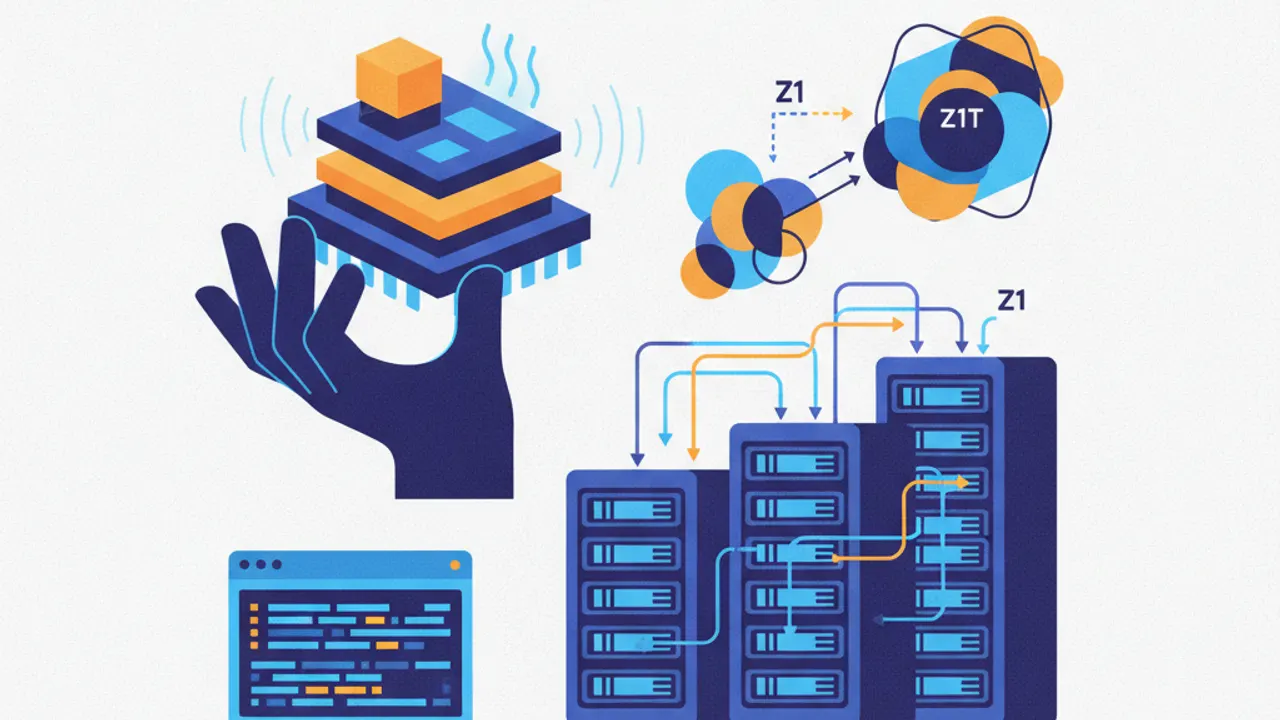
Hardware startup Extropic introduced the Z1T model family alongside its Z1 thermodynamic processor on September 5, 2026. The architecture breaks with the dominant paradigm of deterministic matrix multiplications that govern conventional graphics processing units. By pairing custom models with sub-threshold CMOS hardware, Extropic targets the soaring power consumption of modern neural network inference.
At the core of the Z1 chip lies stochastic physics rather than conventional transistor switching. The processor operates using probabilistic bits, commonly referred to as p-bits, which fluctuate under controlled thermal noise. This design allows the hardware to perform probabilistic calculations natively, circumventing the massive energy overhead of standard digital arithmetic.
Alongside the processor, Extropic revealed the Z1T model family, designed explicitly to exploit the chip's unique physical characteristics. These models utilize sparse transformer architectures, mapping attention mechanisms directly to the hardware's stochastic capabilities. By co-designing hardware and model weights, the company aims to sustain high inference throughput without requiring conventional cooling and power infrastructure.
According to performance figures published by Extropic, the system achieves remarkable efficiency gains. For inference workloads running on sparse transformers, the startup reports an energy efficiency improvement of a factor of 100 to 140 over standard graphics processing units. If substantiated at scale, such reductions could fundamentally alter the cost dynamics of running frontier generative models.
The introduction of Z1 and Z1T highlights an intensifying industry search for non-traditional compute architectures. While GPU clusters remain the standard for training massive foundation models, post-training inference increasingly demands dedicated, low-power solutions. Extropic's thermodynamic approach demonstrates how unconventional silicon designs could establish an alternative path toward sustainable artificial intelligence deployment.