
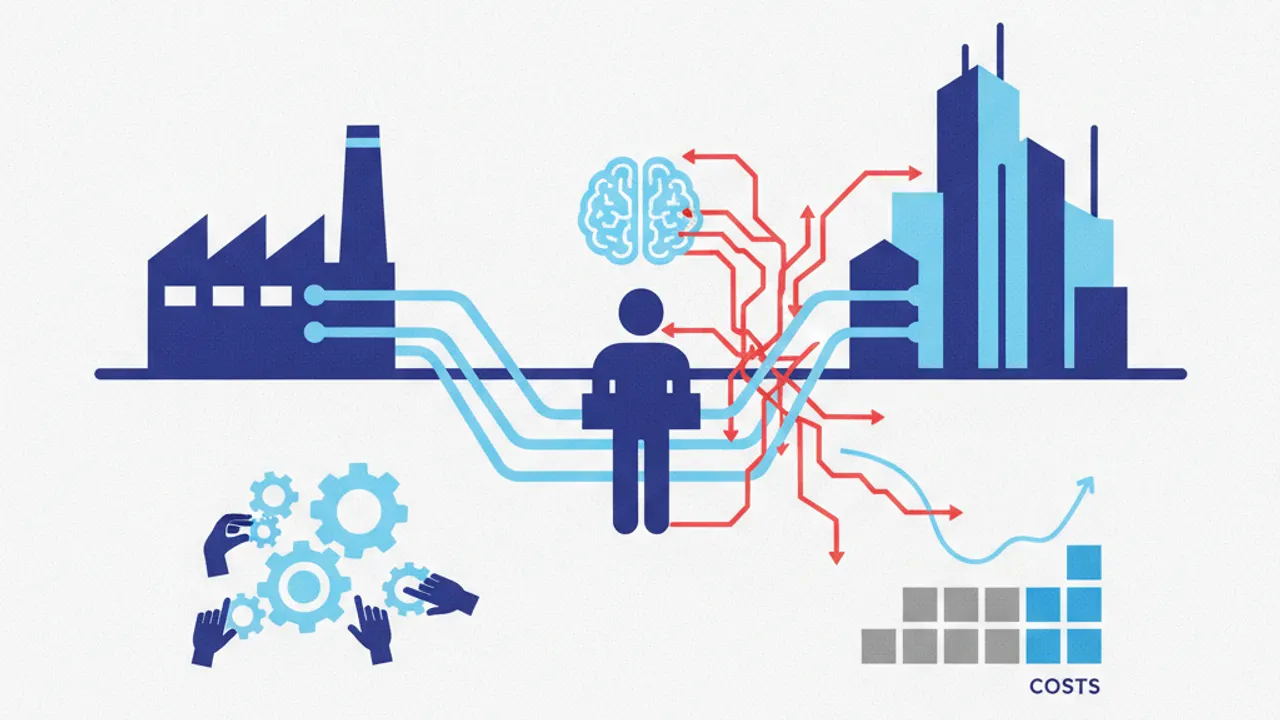
The enthusiasm surrounding artificial intelligence has firmly arrived in the German Mittelstand, yet economic reality is lagging behind initial expectations. A comprehensive study released on November 17, 2026, by consulting firm PwC titled 'From Pilot to Value Creation: How the Mittelstand Scales AI' paints a sobering picture. The research examined 400 German enterprises with annual revenues of at least 50 million euros. The findings document a stark divide between isolated pilot projects and sustainable, profitable operations across core business units.
German enterprises are actively testing modern technology, with 74 percent of surveyed companies currently experimenting with various AI tools. However, bridging the gap to routine operations remains an uphill struggle. Only 23 percent of surveyed businesses have successfully integrated AI applications permanently into their operational workflows. Furthermore, widespread adoption across multiple departments has been achieved by merely 3 to 5 percent of the organizations surveyed by PwC.
The financial results of these initiatives are particularly striking. Contrary to expectations of immediate efficiency dividends, implementing AI rarely results in immediate cost savings. Only 11 percent of companies reported lower overall costs as a result of AI adoption. In contrast, 16 percent faced higher expenses, driven by recurring software licensing fees, external advisory expenses and intricate data preparation workflows. For 70 percent of businesses, total costs remained virtually unchanged.
A complementary study by the German Economic Institute (IW Cologne) published on November 7, 2026, illustrates that structured implementation can yield substantial returns. Organizations that deeply anchor generative models inside core processes achieve an average annual productivity gain of 13 percent. However, based on Destatis figures, the IW analysis reveals an adoption gap: while 57 percent of large industrial corporations utilize AI, the penetration rate among mid-sized companies with 10 to 49 staff members sits at just 23 percent.
This structural shift coincides with major realignments across the domestic employment landscape. Andrea Nahles, head of the Federal Employment Agency, presented a long-term forecast on November 10, 2026, based on calculations from the Institute for Employment Research. The report projects that approximately 800,000 jobs will disappear across Germany over the next 15 years, while an equivalent number of new positions will emerge. Nahles stressed that corporate AI spending must be strictly tied to measurable output gains and workforce upskilling, especially in analytical finance and service roles.
For business leaders across the Mittelstand, these findings represent an important strategic turning point. Unstructured experimentation with conversational assistants and generic tools consumes valuable capital without improving operating margins. Moving from the 16 percent suffering from rising costs to the 13 percent achieving sustained productivity gains requires companies to rebuild data architectures and embed automation directly into revenue-generating workflows.