
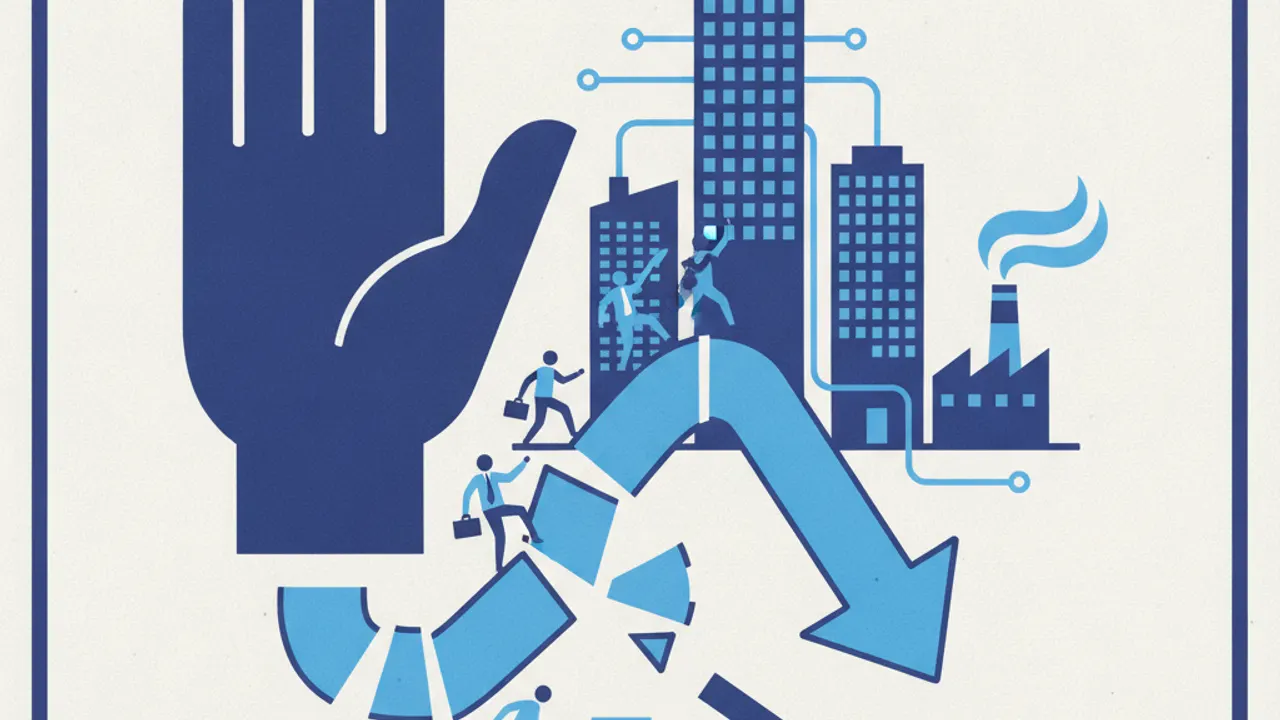
The disruption driven by generative artificial intelligence in the Central European labor market is not manifesting through sudden mass layoffs, but through a gradual blockade of entry-level employment. According to an analysis by economists Benjamin Verschuere and Angus Cameron published in the Frankfurter Allgemeine Zeitung on September 9, 2026, companies are increasingly freezing hiring for junior roles. Instead of cutting experienced staff, employers are absorbing routine workloads with automated processes, creating a bottleneck for university graduates.
Statistical data from the study highlights the sharp impact on young professionals. The hiring and retention rate for 22- to 25-year-olds in cognitive and office-based fields has dropped by 20 percent compared to the prior-year period. The most heavily affected occupations include content writing, introductory software programming, manual data preparation, and general administrative support roles.
This decline coincides directly with ongoing demographic shifts. Many enterprises are using natural retirements to permanently eliminate operational administrative positions, transferring the associated responsibilities directly to automated workflows. For recent graduates, this dynamic removes the traditional junior tier where novice staff historically acquired practical competencies. While organizations resolve short-term cost pressures through automation, they risk eroding their internal talent pipeline for future management roles.
The reluctance to hire junior staff mirrors the rapid expansion of functional AI tools across corporate operations. According to the SME AI Index 2026, published by the German Mittelstand Association and Salesforce, 51.2 percent of mid-sized companies across the DACH region are now running AI tools in production or actively evaluating them. This marks a 54 percent increase year over year, demonstrating that artificial intelligence has become standard practice across core sectors.
At the same time, the operational maturity of software initiatives has risen markedly. Data from the CIO Playbook 2026 shows that 46 percent of proof-of-concept projects now successfully transition into regular production. In 2025, that figure stood at only 12 percent. Furthermore, the share of small and medium-sized enterprises deploying autonomous agents in procurement, sales, or customer support has nearly doubled, rising from 8.7 percent to 16.6 percent.
The primary catalyst for this shift is deep API integration with existing enterprise resource planning and customer relationship systems. Rather than relying on isolated chat interfaces, corporate software directly executes end-to-end business routines without manual junior intervention. For young job seekers, this creates a formidable entry barrier, as companies increasingly demand specialized orchestration and governance capabilities from day one.