
Skip to content
AI ConnectPowered by VELENTIS
AI-generated2 min

Real-Time Tracking and Digital Twins: How AI Is Transforming Pro Sports Officiating and Broadcasting

From split-second referee reviews to 450-millisecond live broadcast explanations: sports governing bodies are accelerating the deployment of real-time AI.

This article was AI-generated and published automatically. Context, labelling and all sources at the end of the article.

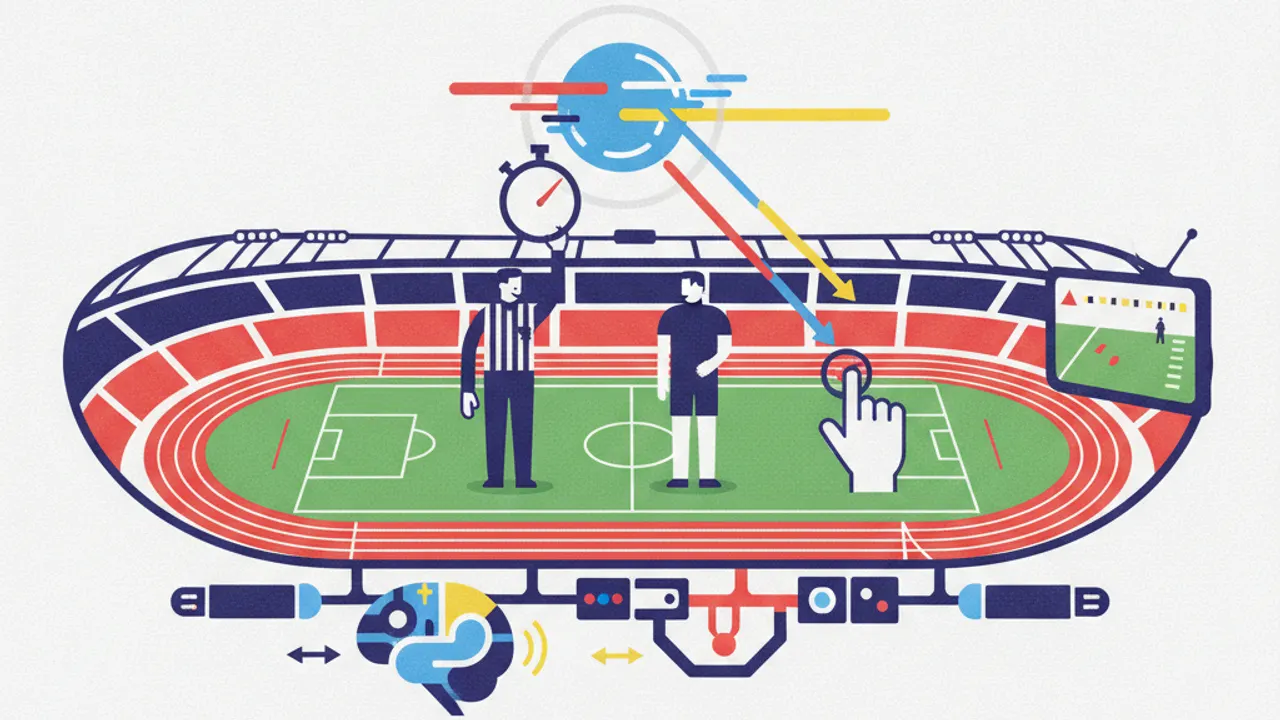
(KI-generiertes Symbolbild: Gemini / AI Connect)

Professional sports are undergoing a comprehensive technological overhaul. Governing bodies and major leagues are increasingly relying on advanced computer vision and machine learning infrastructure to make officiating more objective and cut review times drastically. The International Olympic Committee (IOC) recently detailed a new real-time sports analysis platform that tracks movements live and generates digital twins of athletes. These 3D reconstructions provide judges with objective assistance when evaluating complex multi-axis rotations and difficult-to-view motions. The system is paired with an AI infrastructure designed to shield competitors from cyberbullying and online harassment in real time.

European football is also expanding automated decision support. At the start of the season, Semi-Automated Offside Technology (SAOT) is moving into broader regular operation. High-frequency cameras recording up to 100 frames per second continuously track thousands of mesh points along player body contours alongside ball trajectory. This precise spatial tracking accelerates offside reviews by an average of more than 30 seconds compared to manual line drawing by the Video Assistant Referee.

Major leagues in the United States are deploying complementary optical systems to support officiating crews. Major League Baseball continues to refine its Automated Ball-Strike (ABS) challenge setup, where camera sensors verify pitch calls in fractions of a second. In the NBA, optical pose estimation tracking 29 points per player assists referees with boundary decisions, foot-on-the-line calls and complex goaltending reviews.

The resulting tracking data is also transforming broadcast and fan engagement. Live media partners and federations are utilizing generative analysis engines capable of processing competition scoring data in less than 450 milliseconds. Commentators and viewers receive immediate explanations of point deductions and difficulty tiers as the action unfolds. In parallel, clubs and leagues deploy generative AI agents to monetize off-season dead air through personalized content formats and automated highlight reels driven by predictive fan analytics.

On the training pitch, wearable telemetry is merging directly with positional computer vision. Leading sports technology providers, such as Catapult and KINEXON, integrate biometric metrics like heart rate variability and muscle fatigue with video feeds. Machine learning algorithms analyze asymmetric loading patterns in real time, alerting coaching staffs to overtraining risks before acute muscle injuries occur and allowing proactive substitution strategies.

What this means for you

For spectators and coaching staffs, these deployments translate into fewer lengthy stoppages and greater transparency in contested calls. Merging biometric telemetry with computer vision shifts athlete management toward proactive injury prevention. Broadcasters gain the ability to deliver instant, data-rich context within sub-second timeframes during live matches.

Perspectives

Coverage: 6× Other

One story, several angles: how each source frames the topic, each with a verbatim quote.

  • thecurrent.comOther

    The source highlights how the IOC uses real-time analytics platforms and digital twins to assist officiating and enhance storytelling for broadcasters.

    Original quote

    AI-powered digital twins that recreate movement in near-real time are further helping judges and referees analyze performances

    thecurrent.com
  • trainingground.guruOther

    The article explains how the Premier League is adopting semi-automated optical computer vision technology to speed up offside officiating and provide broadcast graphics.

    Original quote

    It also generates virtual graphics to enhance the in-stadium and broadcast experience for fans.

    trainingground.guru
  • sloansportsconference.comOther

    The conference announcement focuses on how AI-driven systems across leagues like the NBA and MLB are fundamentally altering game officiating and rule adjudication.

    Original quote

    The NBA and MLB are actively testing and deploying AI-driven systems that are fundamentally changing how games are officiated

    sloansportsconference.com
  • premierleague.comOther

    The league's official release details how semi-automated offside technology aims to improve VAR efficiency and deliver enhanced graphics for broadcasters and fans.

    Original quote

    The other big advantage is it will create graphics we can use in-stadium and with broadcasters.

    premierleague.com

Source classification is maintained editorially (political spectrum only where consensus is broad; vendor communication is PR, not journalism). Unlabelled sources are unclassified: we do not guess.

Evidence

Solidly sourced
62/100
  • The IOC detailed a platform that captures movements live to generate digital twins for judges while shielding athletes from online harassment.

    single source
  • SAOT systems utilize high-frequency cameras operating at up to 100 fps, cutting football offside review times by more than 30 seconds compared to manual VAR lines.

    single source
  • IOC live broadcast engines process competition and scoring data with latency under 450 milliseconds to deliver instant TV explanations.

    single source

The evidence score is computed, not hand-set: from confidence, the number of sources and the share of verified statements.

Source & transparency

As of: August 15, 2026

AI-generatedAI-generated: produced automatically from vetted sources with technical quality checks (source, quote and figure verification); no human sign-off of each item before publication

Sources
6
Verified statements
0 / 3
Evidence score
62Solidly sourced

Want to put this into practice?

We connect you with suitable AI providers from the DACH region, free of charge and without obligation.

What's next?