
On September 15, 2026, the German Savings Banks Association (DSGV) presented its annual balance sheet analysis for the German Mittelstand in Berlin. During the press conference, DSGV President Ulrich Reuter emphasized that the actual earnings situation of medium-sized enterprises remains considerably more robust than the persistently depressed sentiment surveys suggest. The presented financial data carries substantial macroeconomic significance, representing approximately 40 percent of total corporate revenues across Germany. The evaluation provides an empirically grounded look at the balance sheets and capital allocation choices of the country's industrial backbone.
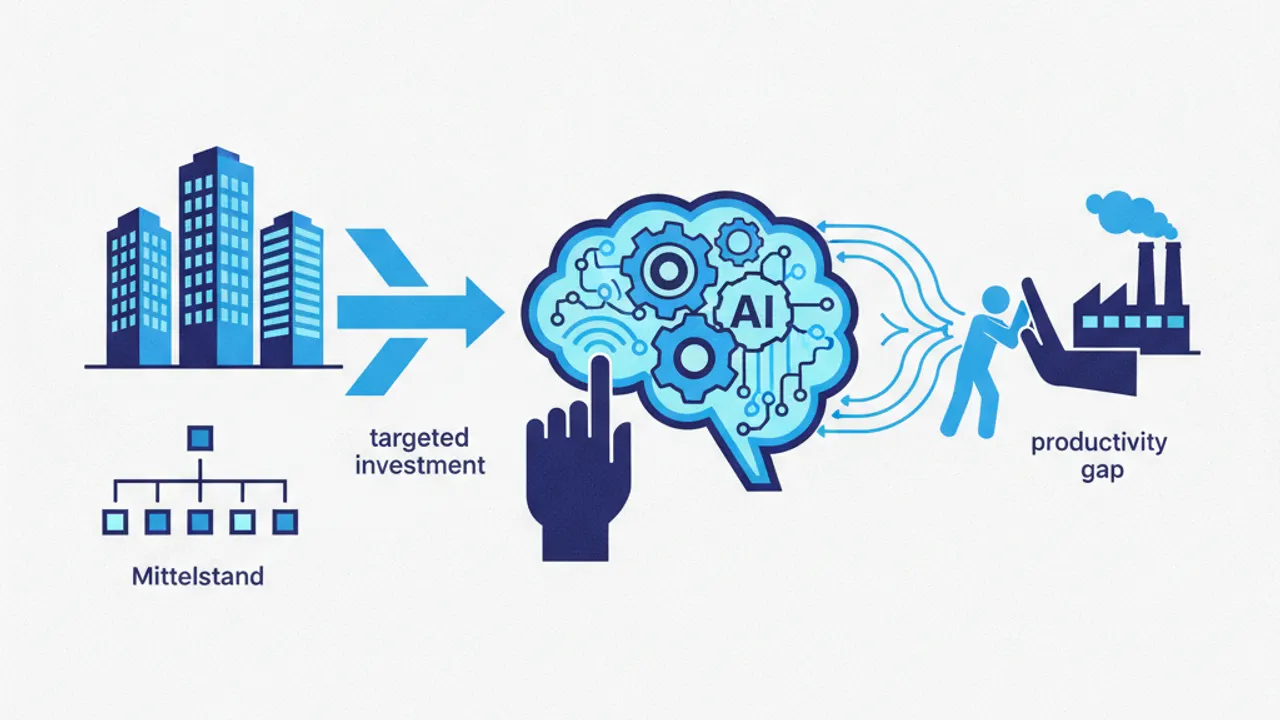
A particularly revealing finding within the DSGV analysis involves the shifting demand patterns for commercial financing across sectors. Growth in corporate investment loans is increasingly directed into automation and applied artificial intelligence projects. Mid-sized companies are actively using these digital implementations to close widening productivity gaps caused by demographic change in their daily operations. Rather than waiting for a turnaround in skilled labor shortages, business leaders are investing in automated workflows to structurally cushion the retirement of older cohorts.
Beyond established Mittelstand enterprises, the analysis also tracks broader momentum across Germany's research-intensive startup ecosystem. According to the DSGV report, Germany counts 38 unicorns in 2026, meaning private growth companies valued at one billion dollars or more. These high-value scale-ups are heavily concentrated in critical future clusters, specifically artificial intelligence, industrial robotics, and deep tech. This distribution confirms that Germany continues to foster market-leading technology firms capable of linking advanced algorithmic models to specialized industrial value chains.
These structural shifts align directly with findings from the September 2026 KPMG study on generative AI in the German economy. Analyzing the operational maturity of enterprises across industries, KPMG observed a clear pivot away from fragmented experimentation. German businesses are no longer prioritizing ad-hoc tool deployments or uncoordinated pilot phases that characterized previous years. Instead, corporate leadership is focusing resources on embedding generative models into enterprise resource planning (ERP) software and core operational systems, supported by rigorous governance frameworks.
Organizations that have instituted cross-functional AI governance and structured internal data access are already seeing measurable operational efficiency gains according to KPMG. These documented productivity improvements appear primarily in administrative functions, including internal business reporting and supply chain coordination. However, the study identifies a persistent structural bottleneck that continues to restrain broader scaling efforts. The primary barrier to enterprise-wide return on investment remains the widespread fragmentation of internal data silos across legacy corporate networks.
The convergence between the DSGV financial figures and the KPMG organizational findings highlights a pragmatic shift across German business. Corporate leadership is moving away from speculative AI enthusiasm toward strict cost-benefit analyses tied directly to verifiable efficiency metrics. The surge in targeted automation loans combined with formal compliance structures demonstrates that enterprise artificial intelligence has transitioned into an operational discipline. Sustaining long-term productivity will ultimately depend on whether companies can resolve legacy data fragmentation fast enough to outpace demographic contraction.