
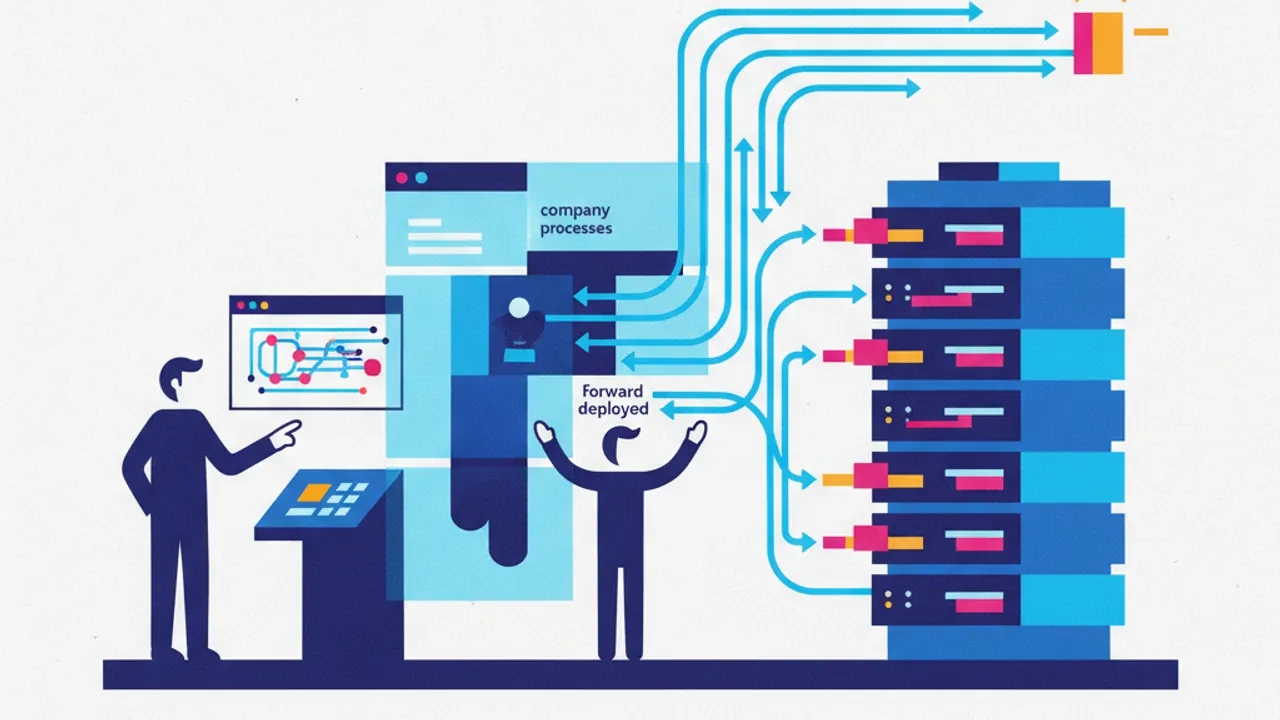
The rapid maturation of generative artificial intelligence and autonomous agent workflows is transforming the engineering profession from the ground up. In an in-depth analysis on the Latent Space platform, Vinoo Ganesh, Chief Executive Officer of Kepler and former lead of Palantir Spark as well as Citadel veteran, outlined the surging significance of the Forward Deployed Engineer. Ganesh argues that modern technology companies face a decisive structural shift because classical software engineering problems across standard SaaS domains are largely solved. Real economic value no longer stems from reinventing established workflows, but from tackling deeply entrenched, unorganized core enterprise operations.
In typical corporate environments, mission-critical operations are rarely well-documented or cleanly structured, presenting a major roadblock for off-the-shelf software solutions. This friction creates a vital opening for Forward Deployed Engineers, who embed themselves directly at the intersection of business operations and emerging artificial intelligence platforms. By immersing themselves in the daily realities of client organizations, these practitioners uncover undocumented dependencies and map messy organizational processes. Ganesh emphasizes that the success or failure of enterprise artificial intelligence deployments hinges on this meticulous frontline engagement.
A core methodological discipline of the role involves dissecting a business domain into its fundamental components, specifically its foundational nouns and verbs. This explicit taxonomy transforms proprietary workflows and corporate actions into a structured logical architecture that machines can reliably interpret. Without such clear boundaries, autonomous agents struggle with ambiguity, hallucinate irrelevant actions, or collapse under conflicting internal terminology. The Forward Deployed Engineer establishes the necessary semantic foundation that enables generative models to execute autonomous reasoning accurately.
Crucially, forward deployed engineering is not meant to devolve into bespoke technical consulting or permanent service work. Ganesh points out that the true objective of a top-tier engineer is to convert tailor-made agent implementations back into standardized, reusable platform modules. By abstracting individual customer fixes into generalizable platform capabilities, engineering teams prevent technical debt and recurring service overhead. Every custom deployment thereby functions as a testing ground that systematically enhances the core software product.
The rising demand for such engineering discipline is mirrored in the day-to-day realities of deploying autonomous coding tools. While modern models can operate independently on multi-step workflows, they routinely generate friction such as messy commit metadata and orphan repository identifiers, colloquially known as agent cruft. Developer Simon Willison recently highlighted this maintenance burden by releasing a dedicated utility, commit-rewriter 0.1, to clean up autonomous artifacts in version control before production publication. As agents take over routine code writing, the human workload shifts from generating syntax to supervising system hygiene and platform stability.
This shift closely aligns with a broader industry critique sparked by essayist Paul Ford, which resonated widely across developer forums following Simon Willison's commentary. Ford pushed back against the widespread assumption that generative artificial intelligence renders software engineers obsolete, noting that letting anyone write code often produces amateurish implementations of complex domains. In his view, the fact that anyone can now program only clarifies why many people should not attempt it without deep domain expertise. The Forward Deployed Engineer represents the logical answer to this dilemma, uniting domain mastery with rigorous platform architecture.