
Skip to content
AI ConnectPowered by VELENTIS
AI-generated2 min

DeepSeek Releases Open-Source Framework DeepSeek Harness and New Flash Vision Model

DeepSeek has introduced DeepSeek Harness v0.1.1, a modular agent framework, alongside the experimental V4-Flash-Vision-Exp model for developers.

This article was AI-generated and published automatically. Context, labelling and all sources at the end of the article.

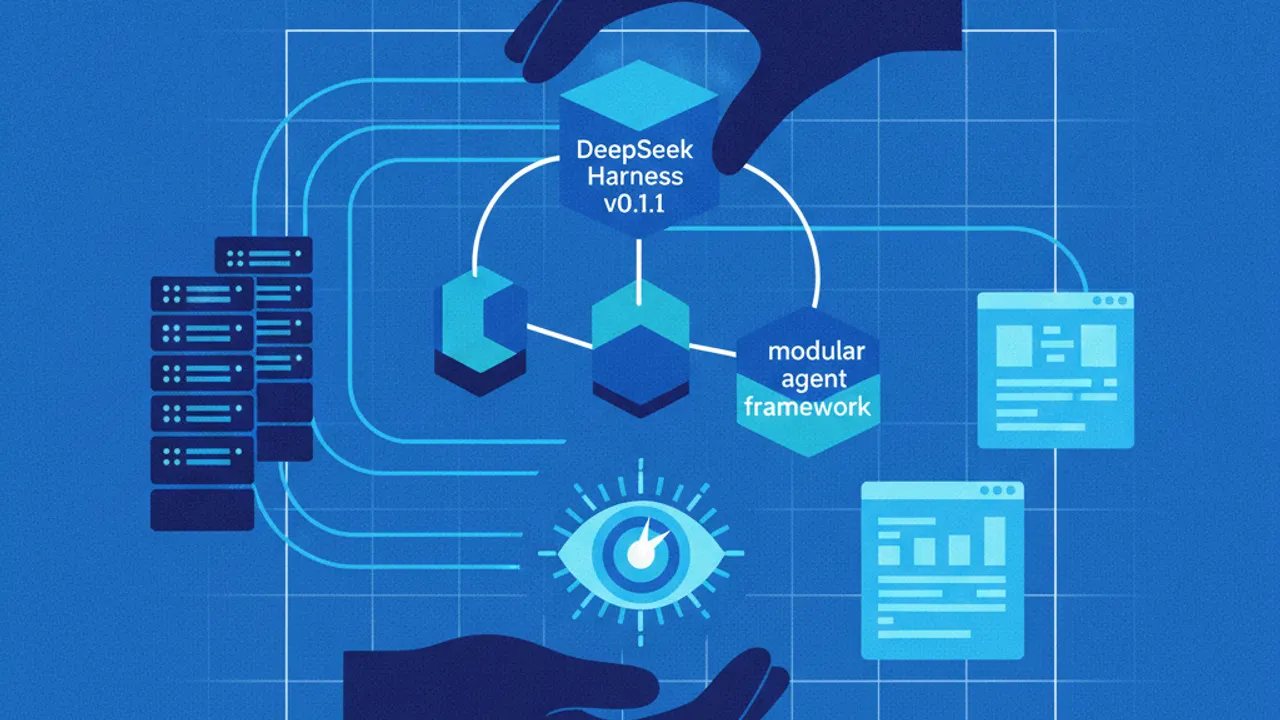
(KI-generiertes Symbolbild: Gemini / AI Connect)

DeepSeek is further expanding its developer ecosystem by releasing a new preview version of its open-source agent framework, DeepSeek Harness. Version 0.1.1 of the tool, designated as dsh, is targeted at developers building autonomous coding pipelines. The system adopts a modular architectural design that treats all primary components as swappable modules. Consequently, the project positions itself as a flexible foundation for complex programming workflows across local and cloud environments.

At the core of DeepSeek Harness is the Cordis architecture, which operates on the premise that everything functions as a plugin. Model routers, shell sandboxing environments, user interfaces, and tool execution engines can be reconfigured or replaced as needed. This design enables developers to integrate third-party sub-agents such as Claude Code or Codex directly as downstream instances. Rather than imposing monolithic execution paths, the framework acts as a mediation layer for specialized AI agents.

Alongside the framework update, DeepSeek launched an experimental model designated as V4-Flash-Vision-Exp for developer testing. This multimodal edition of the Flash model family is specifically tuned for visual agent workflows. Developers can deploy the model to parse screenshots, graphical documentation, and source code within a unified execution pipeline. The release aims to make multimodal capabilities accessible to coding agents without relying on costly closed-source architectures.

Initial internal and community benchmarks indicate high efficiency for the new vision model. In mixed image and code pipelines, the Flash Vision model remains competitive with significantly larger architectures despite low inference costs. This reduces the financial and computational barriers for teams looking to automate visual software validation. The combination of low latency and minimal resource utilization makes the model particularly appealing for high-frequency agentic feedback loops.

The simultaneous release of both tooling components reflects the broader industry movement toward open, modular developer infrastructure in artificial intelligence. Instead of forcing proprietary all-in-one environments, DeepSeek offers configurable building blocks that integrate into existing software stacks. For the open-source community, this approach expands the ability to construct resilient coding assistants without facing vendor lock-in.

What this means for you

For software engineers and AI teams, the release of dsh v0.1.1 and the Flash Vision model provides greater architectural flexibility. The pluggable structure enables developers to orchestrate specialized agents and automate visual code-inspection tasks with significantly reduced inference expenditure.

Perspectives

Coverage: 1× US · 3× Other

One story, several angles: how each source frames the topic, each with a verbatim quote.

  • github.comUS

    The official repository presents DeepSeek Harness as an open-source agent harness built on a fully modular plugin architecture.

    Original quote

    DeepSeek Harness ( dsh ) is an open-source agent harness developed by DeepSeek AI .

    github.com
  • mindstudio.aiOther

    The source examines DeepSeek Harness as a flexible agentic coding framework capable of integrating external agents and tools through an orchestration layer.

    Original quote

    DeepSeek Harness is DeepSeek’s own agentic coding system, released alongside the V4 Pro model as a developer preview.

    mindstudio.ai
  • getamplify.teamOther

    The report frames DeepSeek's experimental Flash vision model as a multimodal advancement competing with top performers like Opus 4.8 on agent benchmarks.

    Original quote

    Deepseek has unveiled V4-Flash-Vision-Exp, an experimental multimodal model that integrates image understanding with its existing V4-Flash text capabilities.

    getamplify.team
  • forum.gnoppix.orgOther

    The source focuses on the market and cost-reduction potential of the model, which aims to deliver top-tier agent performance at a fraction of the computational cost.

    Original quote

    DeepSeek has released an experimental flash vision model that rivals the performance of Anthropic’s Opus 4.8 on agent-based benchmarks.

    forum.gnoppix.org

Source classification is maintained editorially (political spectrum only where consensus is broad; vendor communication is PR, not journalism). Unlabelled sources are unclassified: we do not guess.

Evidence

Solidly sourced
62/100
  • DeepSeek released the updated preview version DeepSeek Harness v0.1.1 (dsh) for autonomous coding agents.

    single source
  • The Cordis architecture of DeepSeek Harness follows an 'Everything is a plugin' paradigm and supports integrating sub-agents such as Claude Code or Codex.

    single source
  • DeepSeek released the experimental V4-Flash-Vision-Exp model for multimodal image and code workflows.

    single source
  • Internal and community benchmarks indicate that DeepSeek V4-Flash-Vision-Exp matches heavier models on agent benchmarks despite low inference costs.

    single source

The evidence score is computed, not hand-set: from confidence, the number of sources and the share of verified statements.

Source & transparency

As of: August 24, 2026

AI-generatedAI-generated: produced automatically from vetted sources with technical quality checks (source, quote and figure verification); no human sign-off of each item before publication

Sources
4
Verified statements
0 / 4
Evidence score
62Solidly sourced

Want to put this into practice?

We connect you with suitable AI providers from the DACH region, free of charge and without obligation.

What's next?