
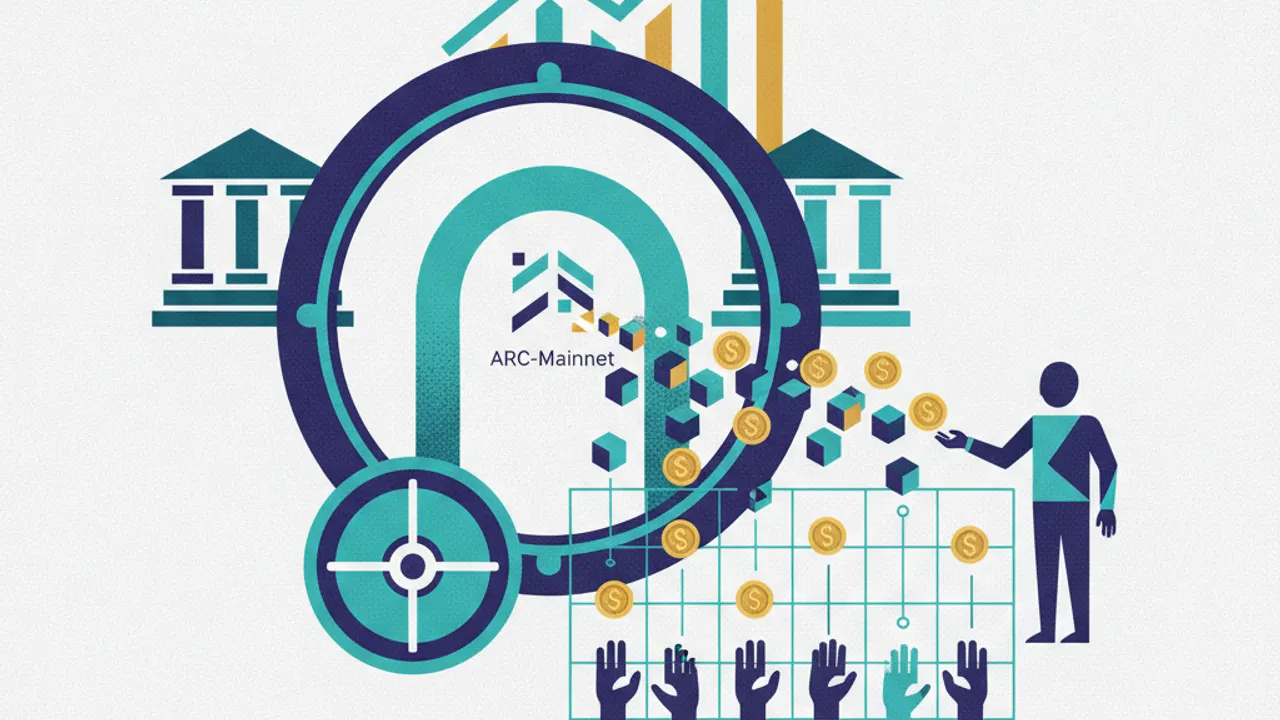
Stablecoin issuer Circle has officially launched the mainnet infrastructure for Arc, an institutional Layer-1 blockchain designed for autonomous machine-to-machine payments and tokenized assets. Circle Chief Executive Officer Jeremy Allaire discussed the deployment during appearances on the podcast The Most Interesting Thing in AI and the industry platform TBPN. Arc is built to serve as a dedicated settlement layer capable of executing automated transactions between software agents in sub-second intervals.
To secure and validate the new blockchain, Circle secured commitments from prominent institutions across traditional finance. Validating consortia and key partners include global asset manager BlackRock, the Depository Trust and Clearing Corporation (DTCC), and payment giant Visa. This institutional backing aims to ensure that transaction flows adhere to the rigorous compliance and security criteria expected in legacy financial systems. Arc is positioned not as an experimental decentralized protocol, but as an institutional-grade financial infrastructure.
Allaire argued that current banking architectures are fundamentally unsuited to the demands of an AI-driven economy. Conventional banking rails and payment processors lack the application programming interfaces required to facilitate autonomous, sub-second microtransactions between machines. According to Allaire, programmable money operated on Arc provides the indispensable economic operating system for agents navigating complex digital supply chains. Software agents purchasing data and computational resources autonomously require immediate, deterministic settlement rather than delayed batch cycles.
The technical launch arrives alongside significant legislative developments in Washington. The United States Senate is actively debating the CLARITY Act, a legislative initiative intended to establish uniform federal reserve requirements for stablecoins and legal frameworks for automated smart-contract payments. Arc's design aligns directly with these evolving requirements, embedding regulatory compliance into automated financial workflows. By synchronizing its network launch with federal legislative efforts, Circle aims to establish a compliant standard before widespread agent adoption.
The emergence of Arc highlights a broader transition toward machine-mediated commerce across financial markets. While consumer banks are experimenting with agentic user interfaces, the financial system previously lacked an institutional settlement layer dedicated to machine-to-machine capital allocation. Circle's strategy hinges on positioning its tokens and smart contracts at the core of agentic financial operations. Its ultimate success will depend on whether software developers and enterprise partners integrate Arc over existing general-purpose networks.