
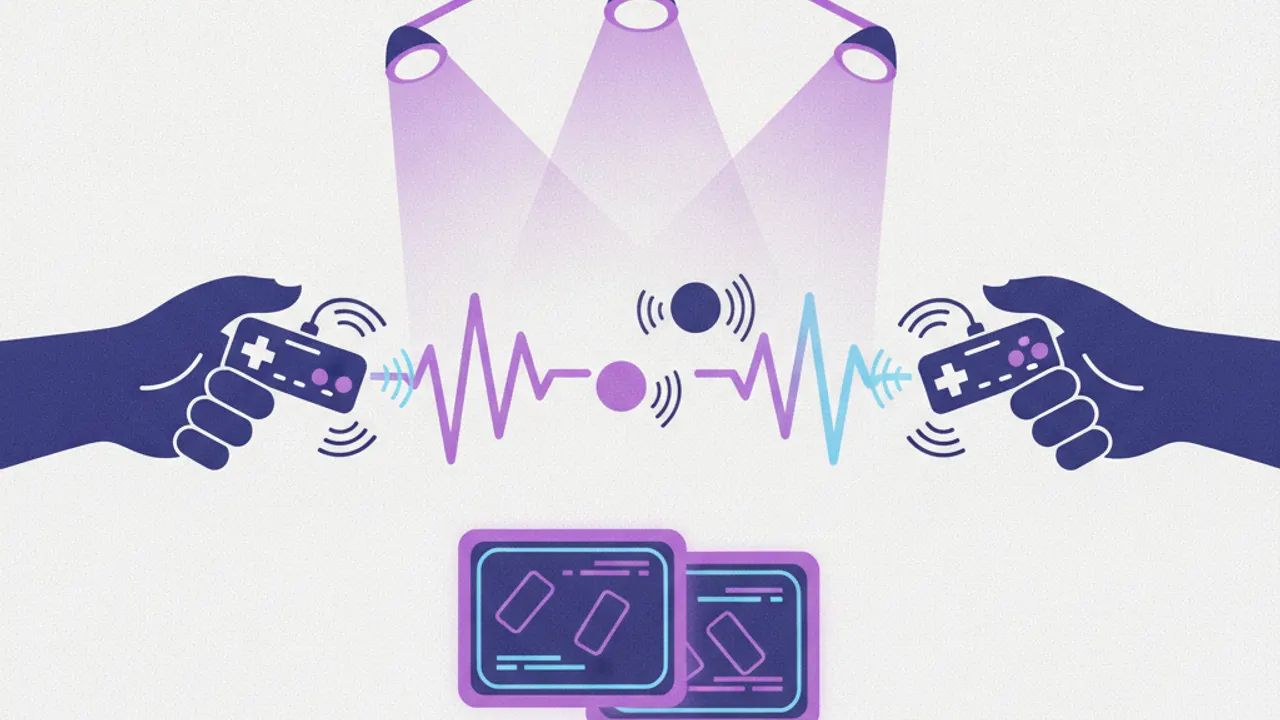
On October 15, 2026, software developer Simon Willison introduced an unconventional technical experiment titled Chirp Pong, a two-player Pong game built entirely in static HTML. The project stands out not for visual complexity, but for its unusual networking model. The game connects two physically adjacent smartphones without relying on any backend server, cloud service, or WebSocket connection.
The synchronization of game states relies solely on acoustic sound waves within the mobile browser. Instead of traditional local wireless protocols like Bluetooth or Wi-Fi, the sending device emits high-frequency audio chirps through its built-in loudspeaker. The opponent device captures these sounds using the standard browser microphone API, decoding the coordinates of paddles and the ball within milliseconds.
The development workflow underscores shifting paradigms in software engineering. Willison did not write the physics engine or the custom audio transmission logic manually. Instead, Chirp Pong was generated entirely through conversational prompting using Claude Opus 5.5 within the Claude Code command-line tool. The language model designed both the signal processing logic and the synchronization protocol based on high-level instructions.
Within web and indie game development, this mechanism addresses longstanding barriers to ad-hoc local multiplayer games. Traditional browser-based peer-to-peer frameworks like WebRTC typically require dedicated signaling servers to establish an initial handshake. By using ambient acoustic data transfer, Chirp Pong eliminates network setup friction, user authentication, and ongoing infrastructure maintenance costs.
The project quickly gained attention across the tech ecosystem, spreading through specialized newsletters such as Latent Space and e/acc. Industry observers cited it as a prime example of vibe coding, where developers steer AI systems toward producing working system-level software without writing boilerplate code. Commentators noted the model's ability to reliably generate functional low-level audio encoders and decoders in JavaScript.
While Chirp Pong remains an experimental prototype, it illustrates practical possibilities for peer-to-peer data exchange in offline environments. Situations lacking cellular connectivity or demanding strict data privacy could benefit from browser-based acoustic communication. The demonstration signals a broader evolution where software creators focus primarily on interface design and logic boundaries rather than low-level implementation details.