
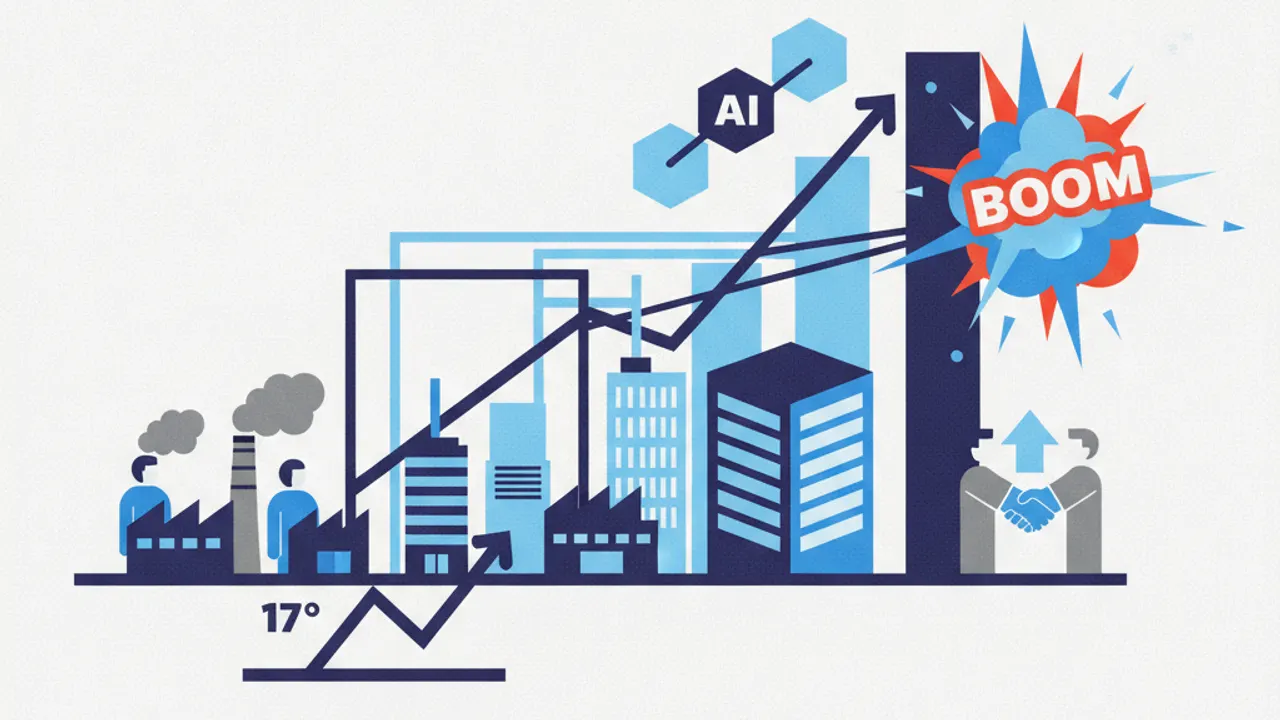
While large parts of traditional German manufacturing continue to contend with stagnation and cautious spending, the domestic electrical and digital industry is experiencing a notable upswing. Massive international investments in artificial intelligence infrastructure are now feeding directly into supplier order books. In August 2026, the sector recorded a sharp 17 percent increase in incoming orders compared to the previous year. This performance stands in stark contrast to broader German manufacturing, which achieved only a modest gain of 2.7 percent over the same period. These metrics highlight a notable decoupling of electrical manufacturing from the broader industrial slowdown.
As Andreas Gontermann, chief economist at the industry association ZVEI, explained on October 7, 2026, the global expansion of modern AI infrastructure serves as the primary growth engine. Data centers designed specifically to train and operate advanced machine learning models require enormous amounts of specialized hardware. German manufacturers are capitalizing on their longstanding expertise in industrial equipment and sophisticated components. This robust international demand is effectively offsetting weaker sales in other traditional industrial customer segments.
The technological catalyst for this demand surge stems from the physical requirements of modern AI facilities. With the exception of the building shell itself, virtually the entire physical infrastructure of a computing center originates from the electrical industry. Key equipment includes uninterruptible power supplies, heavy-duty switchgear, and advanced cooling systems capable of dissipating heat generated by dense computing clusters. In addition, installations rely on precision industrial sensor arrays and high-speed networking hardware, without which coordinated execution across thousands of processing units remains impossible.
This influx of orders is having immediate, tangible consequences for employment across the sector. Data from the Munich-based Ifo Institute and ZVEI indicate that the recent surge in demand has effectively stopped previously expected job cuts. Facing broader economic headwinds, numerous companies had earlier contemplated workforce reductions and restructuring measures to preserve margins. The large-scale delivery contracts tied to international data center projects have now provided a critical stabilizing cushion for payrolls across the industry. This reversal effectively interrupts a downward employment trajectory that continues to trouble other manufacturing sectors.
At the same time, shop-floor operations within electrical manufacturing facilities are undergoing rapid modernization. According to industry figures, approximately 70 percent of production tasks in the German electrical sector are now classified as technically highly semi-automated. Companies are utilizing advanced automation systems to keep pace with rigorous delivery schedules set by global cloud operators. As a result, the very industry supplying the physical foundations for artificial intelligence is running on highly automated production methods itself.
These dynamics highlight the frequently overlooked physical constraints shaping the artificial intelligence expansion. While software models and generative algorithms capture the public imagination, physical power distribution and control hardware dictate the actual pace of real-world deployment. For the German industrial base, this structural shift presents a clear opportunity to establish an indispensable position in the global AI supply chain, far beyond pure software engineering.