
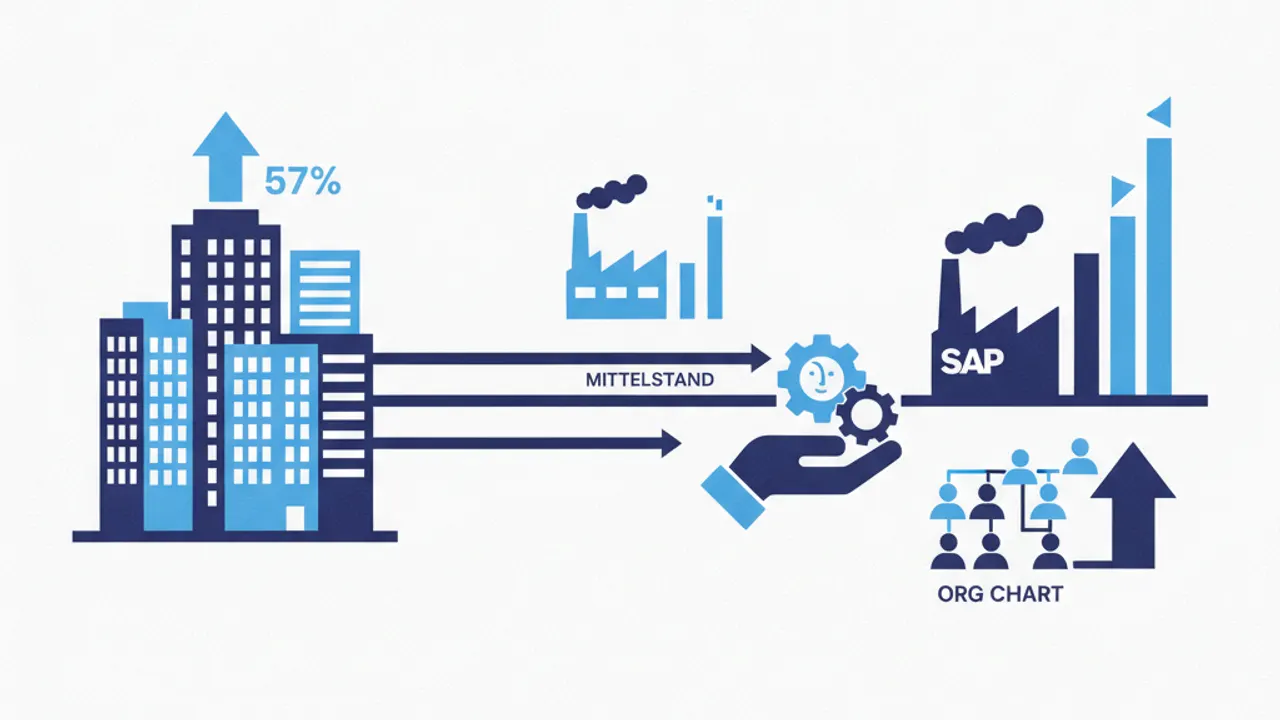
The initial corporate enthusiasm for experimental chatbots is giving way to a sobering reality check across German-speaking economies. Recent data from the industry association Bitkom and state-owned development bank KfW reveal that the adoption of artificial intelligence tools is failing to translate into widespread productivity gains. While more than half of German enterprises have deployed AI software, most organisations remain unable to embed the technology into their core business processes or clear persistent regulatory hurdles.
According to the Bitkom survey, 57 percent of German companies now use artificial intelligence, up sharply from 36 percent in the previous year. However, the qualitative breakdown paints a troubling picture of implementation. Not a single surveyed business reported that it is fully exploiting the potential of AI, while 59 percent stated that they are not leveraging its capabilities at all. Furthermore, one-third of respondents admitted that their adoption was driven primarily by the fear of falling behind competitors rather than a cohesive strategy.
The German Mittelstand presents an equally bifurcated landscape. Figures from KfW Research indicate that only around 20 percent of core small and medium enterprises actively deploy AI in their daily operations. While pioneer firms with integrated strategies do achieve higher margins and above-average revenue growth, the broader sector remains hesitant. Stefan Wintels, chief executive of KfW, emphasized that Germany does not need to become the global leader in model development overnight, but must instead strive to be the number one country in applying AI across industry and the Mittelstand.
Operational bottlenecks and regulatory compliance represent the steepest barriers to establishing autonomous workflows. Compliance with the General Data Protection Regulation and the European Union AI Act was cited by 66 percent of surveyed businesses as a primary obstacle, followed closely by general legal uncertainties at 56 percent. For organisations that have avoided AI entirely, technical capability is the defining deficit: 85 percent of non-users cited a lack of in-house engineering expertise as the main reason for their inaction.
While mid-sized businesses struggle with legal complexity and talent deficits, large software corporations are already reorganizing their workforces to capture automation gains. At software giant SAP, chief executive Christian Klein is accelerating efforts to turn the company into a dedicated AI enterprise. Klein recently reiterated to analysts that internal staffing profiles and headcount requirements will undergo fundamental changes through the end of next year, driven by steep internal productivity leaps enabled by autonomous coding and workflow agents.
This structural transformation is prompting significant labour negotiations. As reported by Manager Magazin on October 2, the SAP works council negotiated comprehensive severance agreements alongside structured reskilling initiatives and internal transfer paths. The measures aim to cushion disruptions in traditional engineering and customer support departments, highlighting how enterprise AI adoption is shifting from speculative software pilots to profound organizational restructuring.