
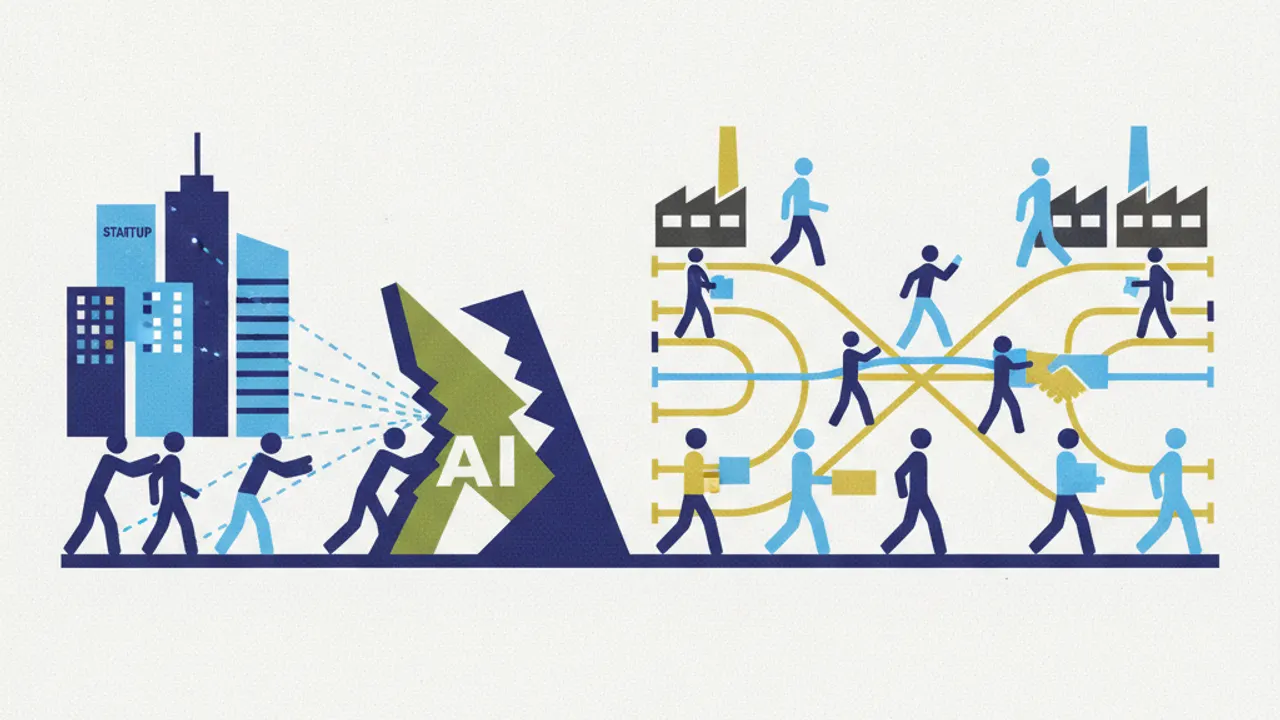
The rapid adoption of artificial intelligence is leaving tangible marks on the workforce planning of young technology firms in Germany. A study published on 21 October 2026 by the digital association Bitkom reveals that more than one in four German tech startups is actively curbing headcount expansion. Specifically, 27 percent of surveyed founders stated that they refrained from hiring new staff over the past twelve months. As the primary reason for this freeze, founders reported that software models and automated workflows had effectively taken over the tasks.
The direct impact of software automation in the startup ecosystem extends well beyond simply pausing recruitment drives. For seven percent of the surveyed startups, productivity gains unlocked by AI systems led directly to workforce reductions. This shift represents a notable departure for an industry historically defined by rapid headcount scaling and an insatiable appetite for talent. Founders increasingly prefer to empower lean core teams with automated agentic pipelines before committing to the fixed overhead of additional payroll.
A markedly different picture emerges when examining the broader macroeconomic landscape across Germany. A concurrent analysis conducted by the German Economic Institute in Cologne, utilizing data from the Federal Employment Agency, provides reassurance against fears of widespread job cuts. Although roughly 12.4 million employees across Germany perform roles characterized by high exposure to generative AI, an above-average increase in unemployment within knowledge-based professions has not materialized. Established companies are predominantly deploying AI solutions to alleviate acute skilled labor shortages rather than to replace their existing staff.
Outside the startup ecosystem, however, the German SME sector continues to grapple with a pronounced adoption paradox. While 57 percent of businesses report utilizing AI tools in their daily operations, the actual economic payoff remains largely unrealized. According to recent autumn 2026 findings from IT-P and the Mittelstand-Digital network, 87 percent of active users admit they barely or not at all exploit the technology's full potential. The majority of traditional enterprises remain stuck in isolated pilot experiments rather than executing systemic transformations across their core business units.
This widespread hesitation is driven by substantial structural barriers that hinder comprehensive deployments across departments. A striking 85 percent of surveyed enterprises cite a lack of internal technical expertise as the primary obstacle preventing deeper technological rollouts. Furthermore, companies struggle with unpredictable integration costs and widespread regulatory uncertainty surrounding the phased implementation of the European Union AI Act. Caught between compliance ambiguities and architectural legacy debt, many traditional leaders remain reluctant to overhaul mission-critical workflows.
Nevertheless, proactive digital adaptation delivers measurable competitive advantages, as highlighted during the IfM Bonn International Roundtable on SMEs on 29 October 2026. Growth-oriented startup founders evaluate their business prospects far more optimistically than their peers in legacy family enterprises. This distinct performance gap arises because modern innovators architect their operational workflows around native AI frameworks from day one. While the broader employment landscape remains resilient, the operational divide between agile adopters and hesitant incumbents is widening at an accelerating pace.