
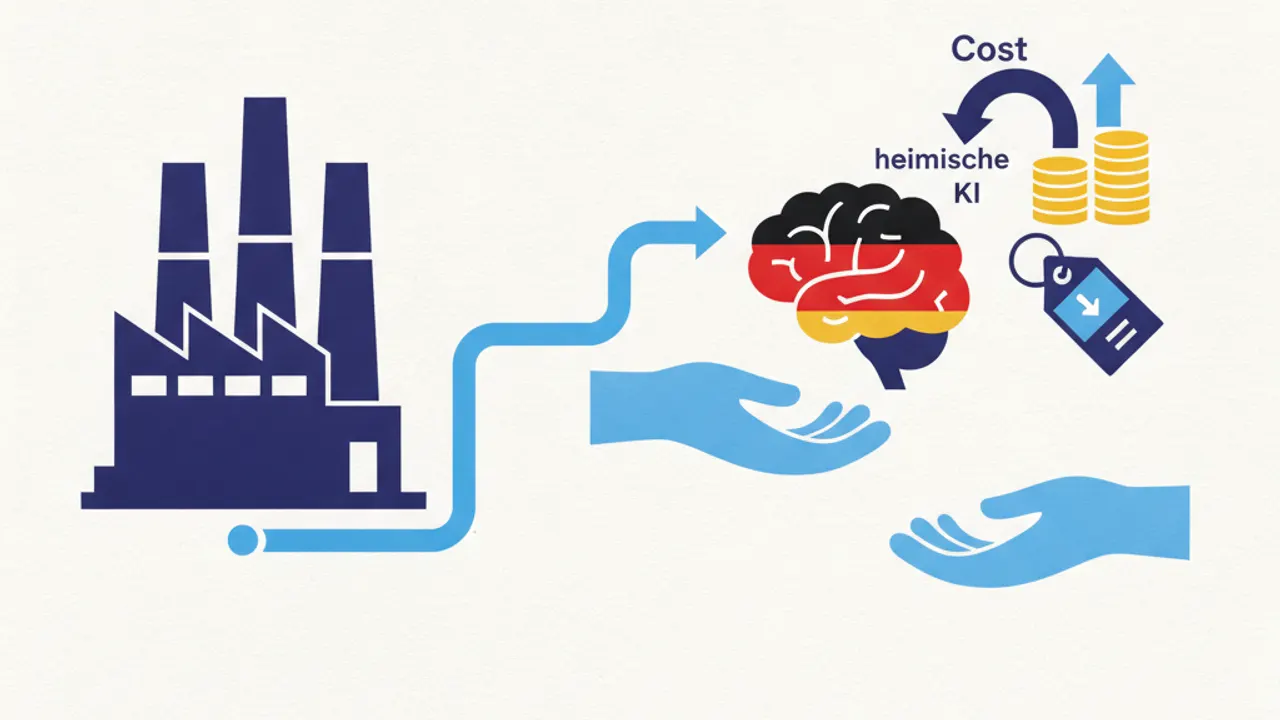
The drive for digital sovereignty has officially reached German executive boards. In conjunction with the federal government Digital Summit, digital association Bitkom released a representative survey of 603 companies. According to the findings, 96 percent of surveyed businesses state a clear preference for artificial intelligence solutions developed in Germany. European alternatives are also gaining momentum, with French offerings seeing notable traction at 46 percent approval. Concurrently, the dominance of American tech platforms is weakening, as preference for US models dropped from 51 percent to 41 percent within a single year.
Yet beneath this commitment lies a severe commercial dilemma for European software providers. A substantial 64 percent of businesses make it clear that they will not accept any functional disadvantages or higher operating costs for the label of being made in Germany or Europe. Consequently, domestic AI developers must compete directly with well funded Silicon Valley platforms without expecting any loyalty bonus from clients. European data centers and model creators face the daunting task of delivering equivalent inference speeds and scalability at pricing levels established by multinational hyperscalers.
Meanwhile, the deployment of generative tools across small and medium-sized enterprises is accelerating rapidly, even as its organizational impact remains constrained. Around 57 percent of German companies with at least 20 employees now deploy AI software, marking a threefold increase compared to 2024. Despite this uptake, not a single company surveyed considers itself to be fully tapping the technology potential. Routine knowledge work regularly registers measurable time savings between 14 and 40 percent, but these desk level gains rarely translate into measurable revenue expansion across the broader organization.
Industry analysts attribute this productivity bottleneck to a persistent leadership deficit within corporate management. Traditional IT directors frequently struggle to reimagine core business models, whereas executive officers often lack the necessary technical literacy to guide platform integration. To bridge this divide, medium-sized enterprises increasingly rely on external transitional appointments, such as interim chief AI officers. These specialists are tasked with transforming isolated pilot projects into enterprise workflows while breaking down institutional silos. Without dedicated strategic oversight, software subscriptions risk remaining unproductive workplace novelties.
The repercussions across the German labor market also present a complex scenario that defies simple automation narratives. Data from Bitkom and the Institute for Employment Research indicates that Germany faces an ongoing deficit of roughly 109,000 IT specialists. While 27 percent of surveyed enterprises anticipate selective staff cuts resulting from automated processes, 42 percent report net hiring needs for specialized developers and data engineers to handle their AI pipelines. Technological adoption is intensifying competition for advanced digital talent rather than alleviating broader recruitment constraints.
In parallel, public policy is seeking to push beyond purely text-based language models into embodied systems. At the Digital Technologies Days in Berlin, the federal research ministry awarded funding for a national Robo Hub led by the German Research Center for Artificial Intelligence in Bremen. The project focuses on bridging physical robotics and autonomous AI for maritime infrastructure and complex industrial production environments. Whether Germany can establish itself as a genuine technology hub depends heavily on whether domestic vendors can turn their sovereignty appeal into commercially viable, high-performance software.