
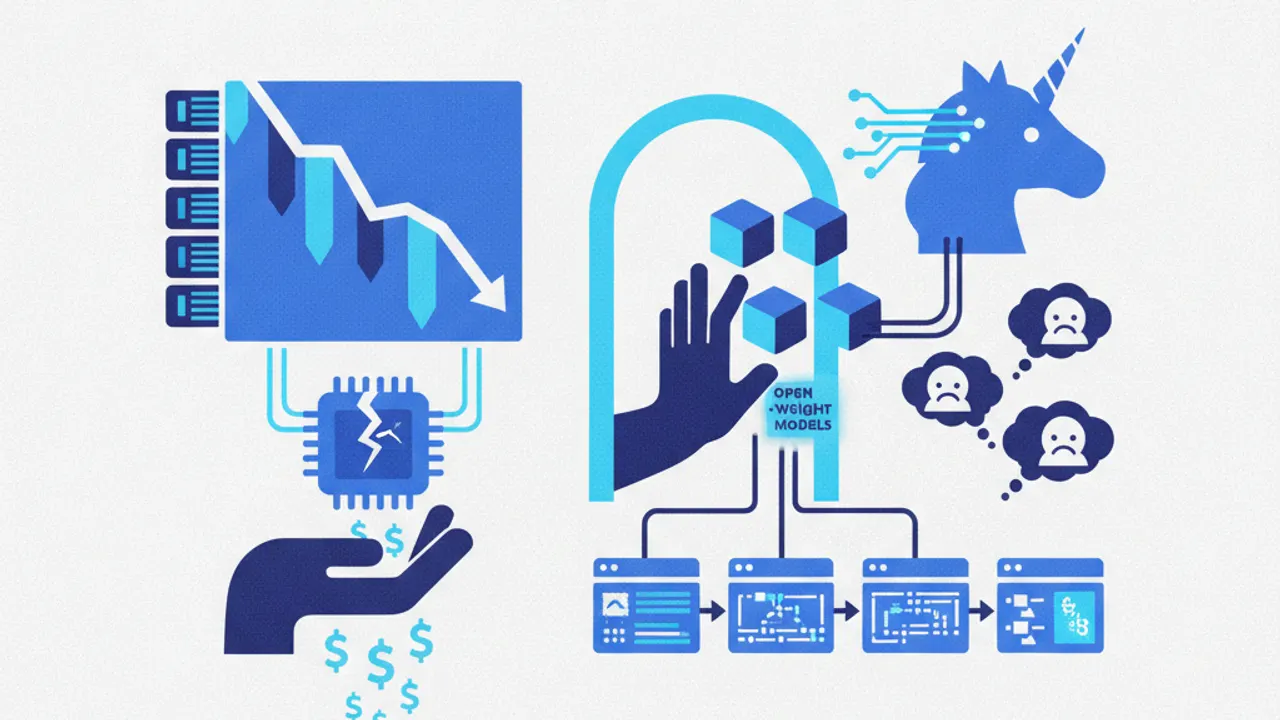
Legal technology unicorn Harvey has long been regarded as the premier commercial success story for generative artificial intelligence within strictly regulated corporate sectors. On September 9, 2026, the company cemented that status by closing a massive 550 million dollar financing round at an overall valuation of 15.5 billion dollars. Behind the scenes, however, the enterprise AI showcase was weathering severe economic disruptions that struck at the heart of its business model. A revealing report from Bloomberg showed that Harvey suffered a precipitous gross margin collapse over the summer, forcing the enterprise darling into a radical overhaul of its core model infrastructure.
According to the revelations, Harvey's gross margin plunged from a healthy positive 50 percent to an alarming minus 50 percent in June 2026. The primary catalyst behind this sudden drop was an unprecedented explosion in compute demand, as client token usage surged twentyfold over the course of the year due to autonomous agent workflows. Because Harvey's automated legal agents relied predominantly on third-party commercial frontier model APIs, the skyrocketing invoice costs quickly outstripped subscription revenues. What enterprise clients experienced as highly capable multi-step legal assistants became an unsustainable cost trap for the startup on every executed task.
To stem the cash drain and rescue its unit economics, Harvey executed a swift technological pivot away from full frontier model dependence. The startup developed and deployed its own post-trained open-weight models, named Harvey Tenet, alongside other low-cost inference alternatives. By routing tasks to specialized open-weight architectures fine-tuned specifically for legal drafting and analysis, Harvey began shifting a significant portion of its inference workload away from expensive proprietary endpoints. This move enabled the platform to maintain required analytical performance while cutting token costs to a manageable fraction of previous API expenses.
The revelations regarding Harvey quickly sparked extensive discussions across Silicon Valley regarding the long-term viability of vertical AI startups. On the TBPN podcast, technology leaders including Snorkel AI founder Alex Ratner and serial entrepreneur Gagan Biyani examined the vulnerability of software platforms relying on closed APIs. Industry observers agreed that vertical AI software providers must actively migrate toward open-weight models to protect their gross margins from catastrophic whiplash. As agentic architectures make dozens of autonomous reasoning calls per user query, standard SaaS pricing quickly breaks down under the weight of external API rate cards.
The lessons of Harvey's margin whiplash extend far beyond legal tech into the broader agentic ecosystem. The imperative for enterprise AI providers to curate custom training data and manage their own models is already driving massive capital reallocation, as seen in Snorkel AI's recent 350 million dollar Series E round. Startups can no longer afford to serve as thin interface wrappers whose unit margins remain at the mercy of closed frontier labs. Harvey's pivot to open weights underscores a structural transition in AI engineering, where customized, cost-controlled open weights take precedence over brute-force reliance on external APIs.