
Software developer Simon Willison has released Battle Drones, a fully playable three-dimensional browser game inspired by the classic real-time strategy title Command & Conquer. The project was constructed without traditional manual programming routines, relying instead almost entirely on autonomous coding agents. Within the international developer community, the experiment is attracting considerable attention as a concrete demonstration of the maturity of vibe coding. Rather than writing code line by line, Willison steered the entire implementation through high-level instructions, deliberately delegating the actual programmatic design and syntax to generative models.
The development chronicle illustrates how far automated software engineering has advanced in practical, production-like environments. The entire project took shape across twelve primary development iterations and comprised a total of 321 individual commits in version control. Willison used the agentic programming tool Claude Code as his primary driver to generate game logic, unit mechanics and visual graphics. Throughout the entire process, he intentionally refrained from inspecting the growing codebase in detail or manually reviewing and fixing underlying functions.
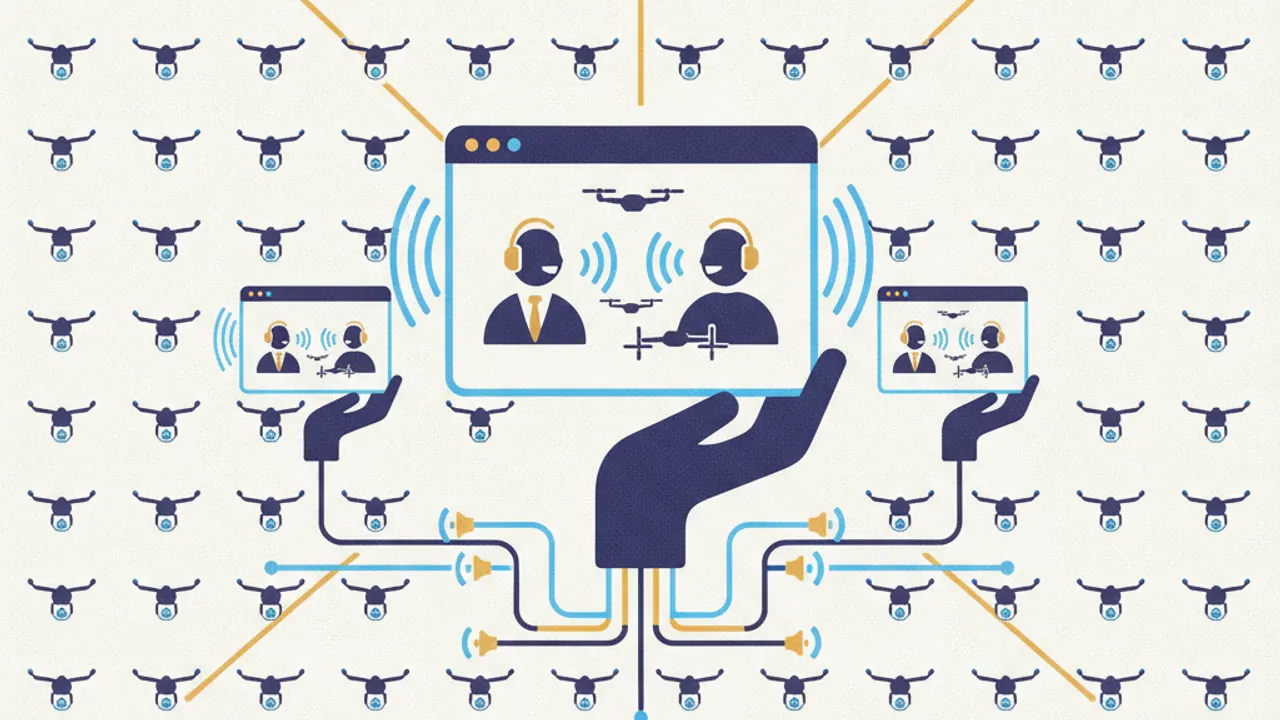
From an architectural perspective, Battle Drones incorporates an unusual and technically challenging multiplayer networking mechanism. Instead of deploying centralized server infrastructure or conventional browser websockets, the system runs a serverless transmission protocol directly inside the web client. State synchronization between two physically adjacent devices is handled entirely through acoustic signals. The participating hardware machines rely solely on their built-in speakers and microphones to transmit, capture and decode game state data locally.
In addition to audio data transmission, the game architecture features battles driven by large language model agents executing tactical decisions in real time. The successful integration of three-dimensional rendering, dynamic game mechanics and local acoustic networking serves as a compelling proof of concept among software engineers. It demonstrates that modern coding agents have moved far beyond generating isolated utility scripts and can independently implement complex, non-trivial system designs. The project proves that even unconventional communication channels and protocols can be orchestrated without granular human code maintenance.
This practical demonstration arrives alongside an intense industry debate regarding the structural evolution of the software engineering profession. Sparked by Jeremy Scheff's widely discussed essay titled 'My obituary for programming', discussions across technical communities like Hacker News have centered on the psychological and operational changes taking place. Historically, software engineers were compensated for solving intricate logical puzzles and handcrafting reliable algorithms. That classic foundation of programming is rapidly eroding as generative systems take over routine implementation and complex programming tasks alike.
According to Scheff's analysis, the core responsibility of developers is quickly pivoting toward overarching system architecture and the active supervision of autonomous refactoring agents. These specialized tools can already optimize, restructure and accelerate existing codebases by a factor of two to three at the touch of a button. For technical professionals, this represents a fundamental transition away from manual line-by-line coding to the role of an architectural director. Projects like Battle Drones demonstrate that this structural redistribution of engineering labor has already transitioned from speculative theory into working software.