
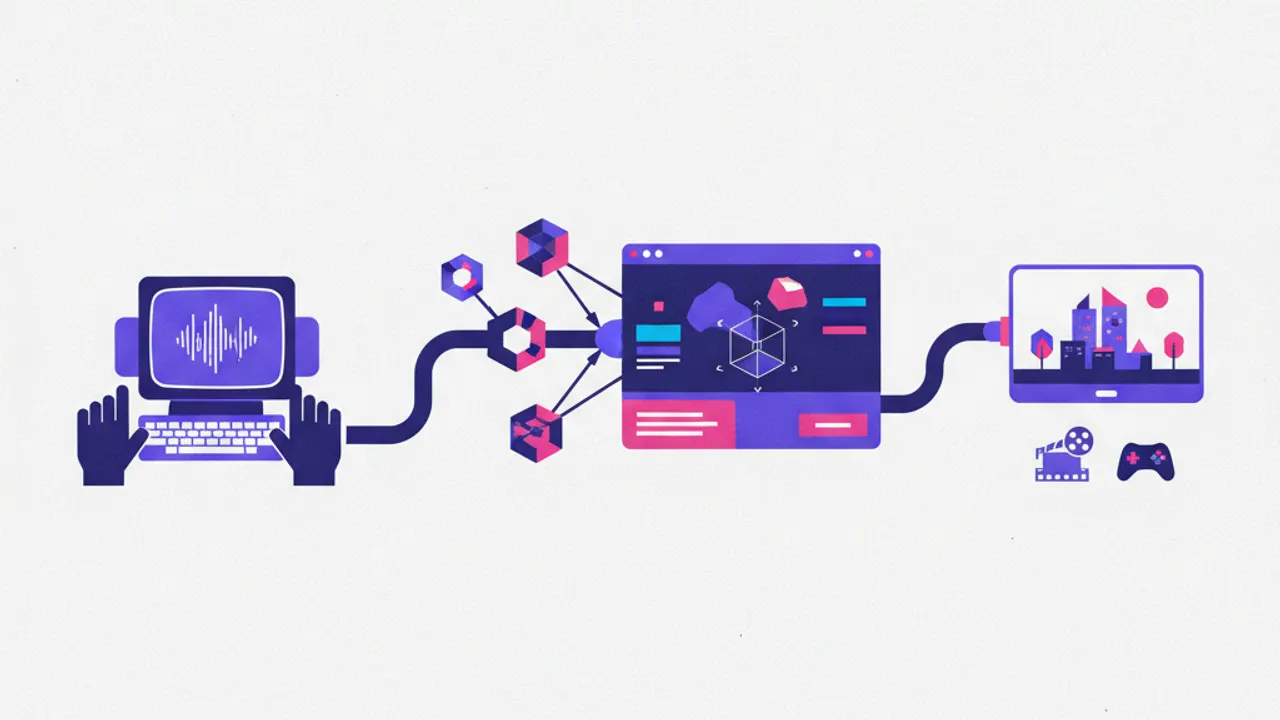
Software developer Simon Willison and open-source contributors have introduced an effective methodology where coding agents utilize local creative software directly as an execution runtime. Rather than using models such as ChatGPT Codex or GPT-6 Astra solely to generate isolated text or static 3D meshes, developers are connecting them directly to the Blender application on macOS. This approach shifts the workflow away from web-based chat interfaces toward deep integration with the local developer environment. Through iterative prompts, the agents write code independently and control the suite without any manual interface interaction.
The technical foundation relies on headless execution via the macOS command line. Using the command /Applications/Blender.app/Contents/MacOS/Blender --background --python scene.py, the system runs the agent-generated scripts entirely in the background without loading a graphical user interface. Developers configure dedicated Local Blender Skills that provide the models with predefined function libraries and conventions. The agent drafts the procedural Python code for the intended 3D elements, triggers execution in the terminal, and evaluates error logs to correct its code autonomously within the same cycle.
The resulting outputs extend well beyond basic primitive shapes. In practical demonstrations documented in the GitHub repository simonw/gpt-6-astra-blender-pelican-bicycle, the agents constructed comprehensive scenes featuring sophisticated material properties, deliberate lighting setups, and automated camera trajectories. The process generates native .blend project files that remain fully accessible for human artists to inspect and modify. Additionally, the setup integrates the command-line tool ffmpeg to render and compile the computed image frames into finished video clips.
This architecture represents a noticeable shift away from conventional generative 3D modeling pipelines. Traditional generative systems frequently output rigid point clouds or untextured polygonal meshes that prove difficult to manipulate, rig, or clean up within professional VFX and gaming pipelines. Because the agent authors clean Python scripts, the hierarchical construction of the 3D scene remains completely transparent and editable. Artists and engineers can adjust numerical parameters such as lighting angles, texture scales, or object coordinates directly in code.
For independent game studios and animation teams, this workflow introduces meaningful automation to asset creation and prototyping. Repetitive tasks such as configuring scene layouts, testing camera movements, or preparing storyboard drafts can now be delegated to script agents. Creative desktop applications are effectively transformed from interactive point-and-click tools into headless engines driven by autonomous code generation. This allows rapid iteration cycles where asset variations are scripted and rendered in parallel.
Despite these concrete advances, technical constraints persist when managing highly intricate scene graphs. Language models can still struggle with spatial consistency, object collisions, and deeply nested shader networks when scenes scale in complexity. Nevertheless, the methodology illustrates how mature desktop software can be seamlessly integrated into agentic workflows through standard command-line interfaces. Combining headless execution, local Python scripting, and advanced coding models provides a clear foundation for automated creative tooling.