
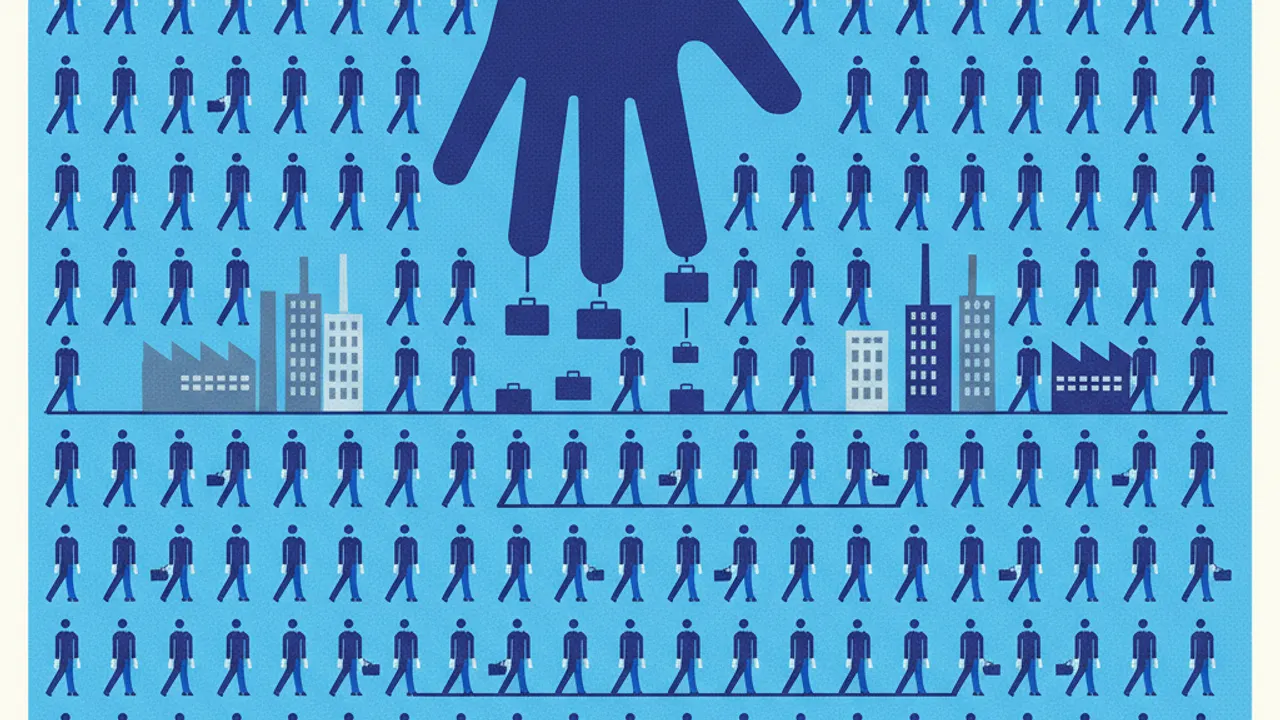
The German labor market is experiencing a pronounced shift in knowledge-intensive sectors at the expense of young career starters. While experienced professionals in fields with high AI exposure remain largely stable in employment, entry-level opportunities for graduates are shrinking rapidly. Recent evaluations by the ifo Institute and figures from the Federal Employment Agency show that traditional junior tasks are increasingly being displaced by automated software. The bottom rungs of the professional career ladder are breaking away in central segments of the economy.
Statistical findings from the ifo Institute paint an alarming picture for young adults aged 20 to 24. While overall employment in occupational groups strongly exposed to AI recorded a slight increase of 1.8 percent, the number of young employees in these identical segments dropped by 14 percent. Economists calculate that this gap represents roughly 34,000 junior workers who have been locked out of traditional career starts. Employers appear to favor software tools for standard entry-level tasks rather than training new graduates.
This structural development is also visible in official unemployment records analyzed by Der Spiegel on 21 November 2026. In October 2026, a total of 358,000 university graduates were registered as unemployed across Germany. The trend among those under the age of 30 is particularly stark, with their unemployment count doubling within just five years to nearly 47,000. Many young academics are entering a market that no longer relies on entry-level human labor to fulfill basic analytical services.
The cause behind this selective downturn lies in the nature of tasks that contemporary AI models handle reliably. Duties like preliminary research, basic coding, drafting text, and statistical data preparation have served for decades as the foundational training ground for junior employees. Because modern systems complete these assignments in seconds and at minimal expense, the financial justification for hiring entry-level workers to perform routine tasks has vanished. Experienced professionals simply employ AI tools to absorb that preliminary work themselves.
Looking ahead, companies face the pressing question of how to cultivate future senior specialists once the entry level has disappeared. A scenario analysis by the Institute for Employment Research (IAB) projects that up to 800,000 jobs in Germany will be substituted by AI over the next 15 years. At the same time, the IAB expects a largely neutral net employment outcome. The loss of routine positions is projected to be offset by emerging roles in fields such as prompt engineering, AI governance, and complex system integration.
Nevertheless, these shifts pose severe challenges for university graduates transitioning into professional practice. Newly emerging roles typically require a mature understanding of system architecture and business operations that fresh graduates rarely possess. While veteran staff leverage AI to multiply their output, new entrants must demonstrate capabilities that were previously acquired only after years on the job. The transformation is altering not only job profiles, but the structural apprenticeship of the next generation.