
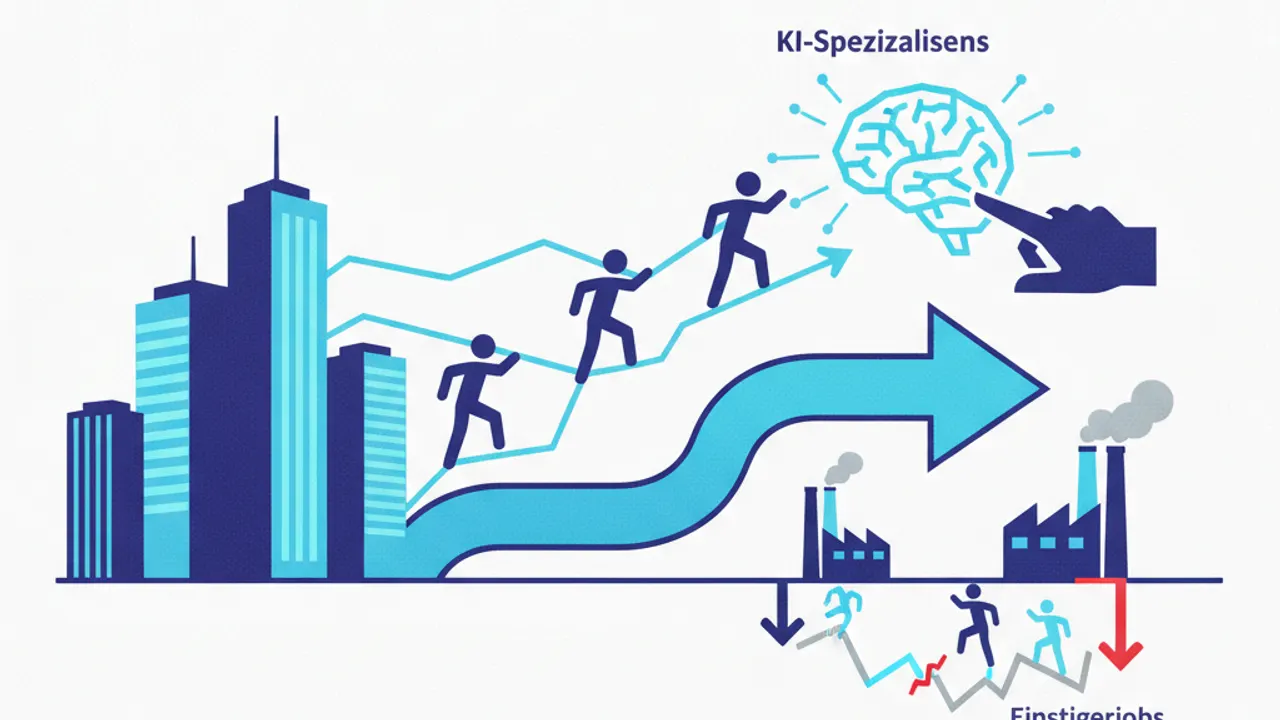
Recent labor market analyses across the DACH region provide clear evidence regarding the structural impact of artificial intelligence on corporate hiring. The Swiss AI Jobs Report, published by the Lucerne University of Applied Sciences and Arts (HSLU), documents nearly 5,000 job postings with direct AI relevance in Switzerland between July 2025 and June 2026. This represents a substantial increase of 32 percent compared to the prior twelve-month period. Contrary to common assumptions that multinational tech giants drive the majority of this hiring activity, small and medium enterprises form the actual backbone of the boom. Mid-sized companies accounted for 76 percent of total job growth and currently offer 62 percent of all open AI positions in the country.
At the same time, the Lucerne study highlights an emerging qualification paradox that is altering career pathways for early-career professionals. While postings for seasoned specialists in data and machine learning engineering expanded by 42 percent, opportunities for junior profiles are contracting rapidly. Companies are increasingly reluctant to hire entry-level personnel because generative models and agentic workflows reliably execute repetitive tasks. Foundational duties such as raw data cleaning, basic code generation, and standard implementation routines are now systematically handed off to software systems. Consequently, the traditional corporate apprentice model in technical professions faces an acute structural challenge.
These structural shifts extend far beyond technical developer environments into general corporate administration. An analysis by Dr. Web based on official reporting data from the Federal Employment Agency and the Institute for Employment Research (IAB) underscores the extent of this contraction. The number of registered vacancies for office and secretarial occupations under occupational group 714 plunged by 51 percent between September 2023 and September 2026. Only 11,863 open positions remained across Germany in this segment, contrasted against roughly 200,000 registered unemployed candidates. This imbalance represents a ratio of 16.8 job seekers for every available vacancy.
The Institute for Employment Research explicitly attributes this sharp drop among business service providers to the operational deployment of generative AI workflows. Routine processes in correspondence, preliminary accounting, scheduling, and document processing are increasingly completed through automated software agents. Tasks that previously required dedicated administrative assistants to draft documents or summarize meeting records are now handled inside enterprise AI environments. As routine administrative demand remains permanently subdued, affected workers encounter heightened hurdles when seeking to re-enter the traditional administrative workforce.
Despite the severe disruption in transactional occupations, economic researchers emphasize that productivity gains from AI are essential to offset impending demographic pressures. A long-term projection by the German Economic Institute (IW), published in the Rheinische Post, estimates that the German working-age population will shrink by 7.7 percent by 2040, representing a deficit of approximately 4.3 million people. The institute projects that annual potential growth could accelerate from its current rate of 0.3 percent to 0.7 percent between 2030 and 2035, and reach up to 1.0 percent in the late 2030s. Achieving this trajectory depends on aggressive capital investments and widespread AI adoption to compensate for the shrinking labor supply.
To realize these gains, however, businesses must overcome persistent bottlenecks in operational implementation and workforce integration. The German Economic Institute warns that sustained investment reluctance among mid-sized companies prevents deep integration across core value chains. Complementary findings from the Allianz Pulse report indicate that only 37 percent of German employees and 44 percent of Austrian workers regularly apply AI tools in their daily jobs. By comparison, corporate adoption rates stand at 52 percent in the United States and 51 percent in the United Kingdom. Without standardized governance frameworks and targeted training initiatives, mid-sized enterprises risk falling behind while administrative job losses continue unabated.