
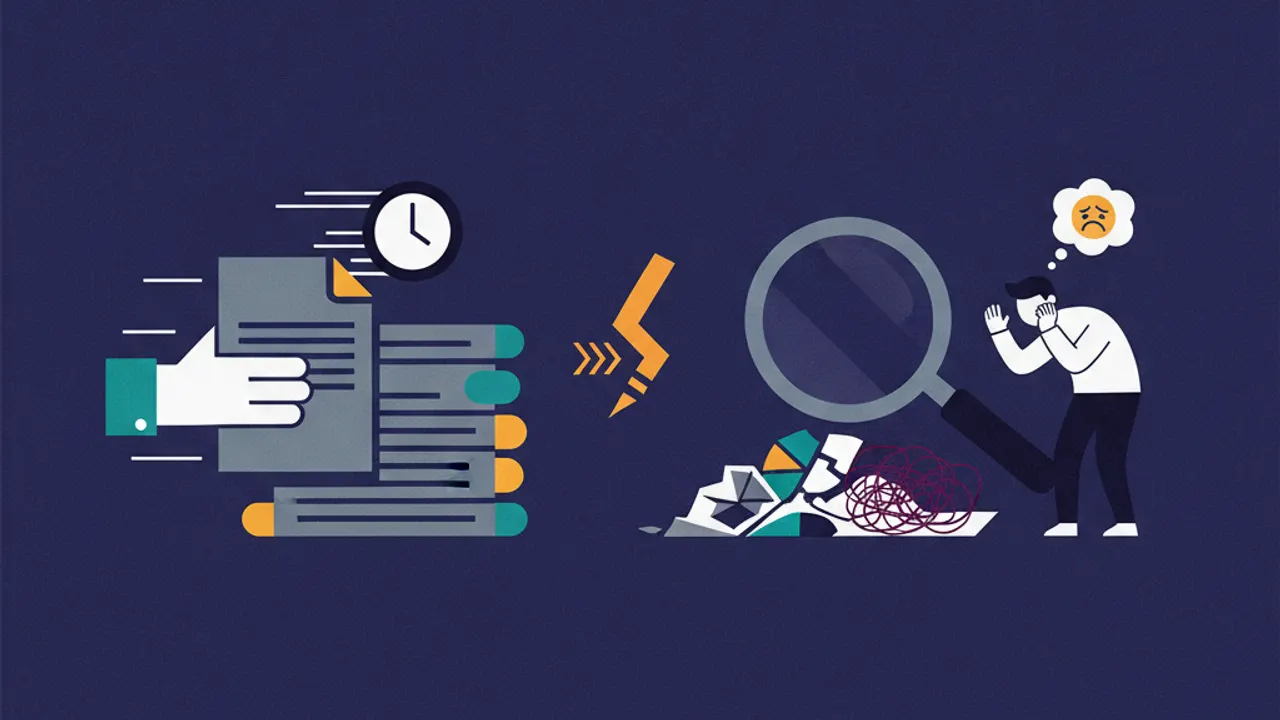
On August 5, 2026, consulting firm Adaptavist published a comprehensive study conducted with Attest among 2,500 knowledge workers across Germany, the United States, the United Kingdom, Canada, and Spain. The research paints a complex picture of ongoing digitalization within modern corporate environments. While management expects productivity boosts, an increasing number of employees report heightened workloads caused by verifying automated output. This additional review overhead leads to unexpected delays across daily team workflows.
Specifically, 49 percent of surveyed employees state that AI-generated content actually reduces overall team efficiency. Respondents identify the heavy manual effort required to verify, correct, and quality-check automated drafts as the primary cause. Furthermore, 39 percent of workers report suffering from explicit AI fatigue in their day-to-day work. This operational fatigue causes staff to reduce their usage of newly deployed AI tools after initial testing periods.
Beyond operational bottlenecks, the study uncovers profound psychological impacts on the corporate workforce. A total of 45 percent of respondents feel that their altered work routine has become noticeably less meaningful. Remarkably, 72 percent of workers express nostalgia for the workplace environment that existed prior to the widespread rollout of generative AI tools. This growing dissatisfaction spans multiple demographics, yet displays unexpected generational variances.
Contrary to common assumptions, younger employees exhibit the strongest reservations regarding the transformation. While only 35 percent of Generation X respondents express nostalgia for the pre-AI workplace, that figure reaches 56 percent among Generation Z workers. For younger professionals, automated workflows appear to generate frustration over repetitive verification tasks rather than providing genuine relief.
A striking contrast to these concerns emerges from an Adobe study published on August 7, 2026, focusing on document processing in Germany. According to the Adobe Acrobat Report, 67 percent of surveyed German workers save up to 8 hours of working time per week by using AI features in document workflows. Key use cases driving these gains include automated text summarization, data extraction, and content analysis.
Despite these substantial time savings, the Adobe report highlights remaining barriers to widespread corporate adoption. The 1,500 surveyed professionals in Germany cite strict data privacy concerns and lingering doubts regarding text accuracy as primary obstacles. If organizations fail to address accuracy concerns, theoretical efficiency gains risk being eroded by tedious manual editing.
The findings of both reports underscore the tension between theoretical efficiency potential and daily operational reality. Organizations must realize that rolling out software without clear quality assurance guidelines or workload relief will likely trigger employee fatigue. Long-term workplace adoption depends heavily on whether staff perceive AI tools as genuine assistance rather than an added burden of manual oversight.