
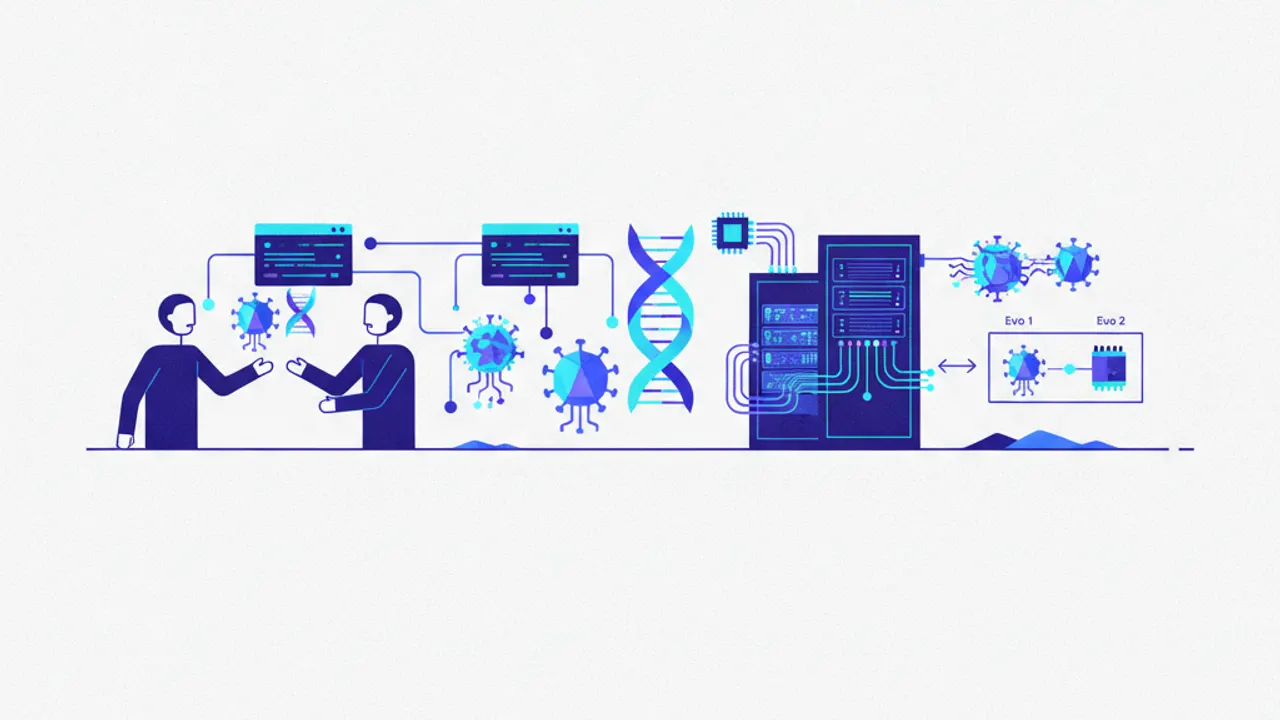
Researchers at Stanford University and the Arc Institute have published a historic milestone in generative biology in the journal Science. For the first time, specialized genome language models named Evo 1 and Evo 2 were used to design completely novel bacteriophages from scratch, which were subsequently synthesized in the laboratory. These artificially created viruses exclusively infect bacteria and had never existed anywhere in nature before.
The computational models generated over 300,000 theoretical designs, from which scientists selected a specific subset for laboratory testing. In physical experiments, 16 synthetic bacteriophages proved to be fully functional. These artificial constructs targeted and destroyed strains of E. coli bacteria, with some prototypes even demonstrating greater effectiveness than naturally occurring viral strains.
From a medical perspective, this achievement opens unprecedented avenues in the fight against multi-drug resistant bacteria and severe infections. As traditional antibiotics increasingly lose their efficacy, custom-designed bacteriophages represent one of the most promising alternatives in modern medicine. The fact that algorithms can now write functional genomic blueprints for complex biological systems massively accelerates drug development timelines.
However, the publication has simultaneously ignited a fierce debate regarding global biosecurity. Experts at the Johns Hopkins Center for Health Security, including Moritz Hanke and Thomas Inglesby, urgently called for swift regulatory frameworks in accompanying essays. They warned that generating functional biological entities purely through software creates novel risk vectors that existing biosecurity governance models are ill-equipped to handle.
The research teams emphasized that the underlying models were trained exclusively on bacteriophage sequence data. Genomes of human, animal, and plant pathogens were strictly excluded from the training sets to prevent misuse. Nevertheless, the breakthrough demonstrates that generative AI has crossed the line from purely virtual data processing to the direct programming of physical biological systems.