
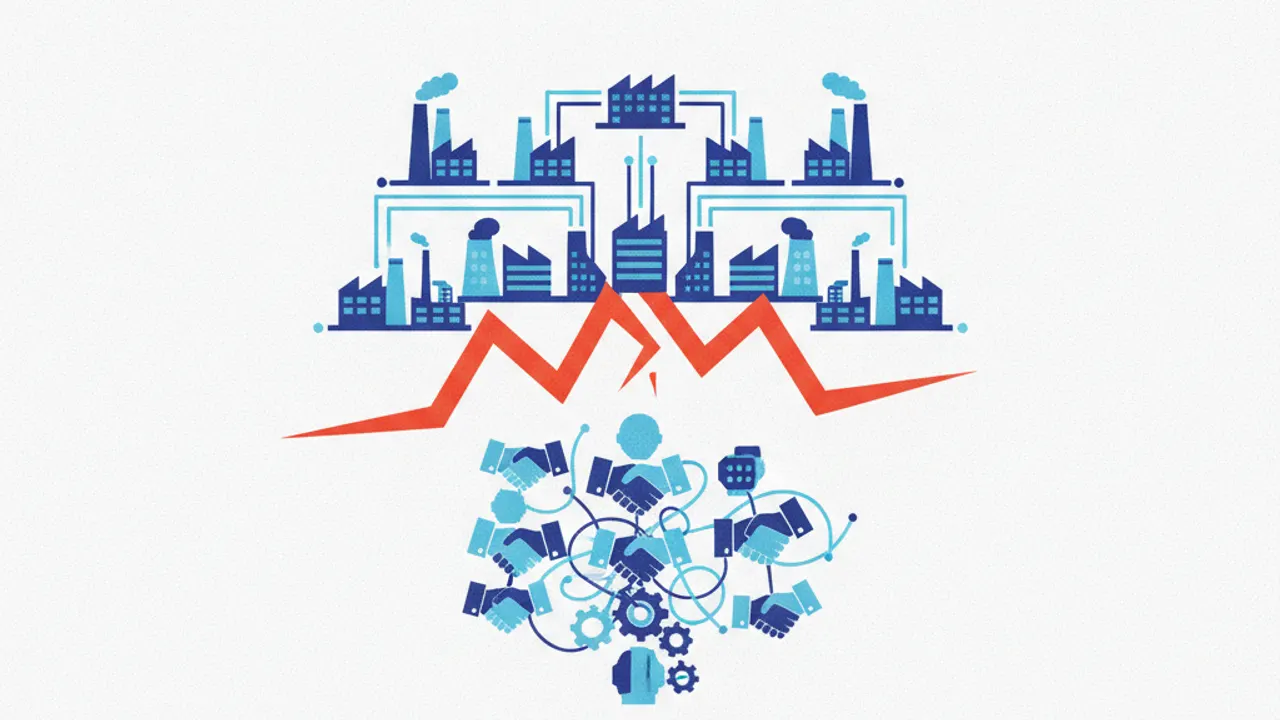
According to recent data from the ifo Institute, 54.5 percent of German companies actively used artificial intelligence in May 2026. This represents a significant increase compared to the previous year, when the rate stood at 40.9 percent. Large corporations lead the adoption curve at 67.2 percent, followed by micro-enterprises at 51.2 percent. Meanwhile, medium-sized businesses lag behind at 47.2 percent due to specific operational constraints.
This disparity highlights a structural bottleneck within the German mid-market. While large enterprises run dedicated digital units and micro-firms rapidly deploy standard tools, medium-sized companies face legal uncertainty and missing technical interfaces. Furthermore, persistent staff shortages slow down the real-world deployment of AI solutions. A study by aithoria and the OECD reveals that 38.7 percent of German SMEs use generative AI, an OECD top score. However, only four percent of these businesses have embedded AI strategically across the entire enterprise.
The labor market reflects a similar dichotomy, as highlighted by the PwC AI Jobs Barometer. AI-related job postings in Germany reached a record high of 1.3 percent of all job advertisements, translating to roughly 125,000 open positions. Despite this soaring demand for AI skills, PwC identifies a surprising decoupling in job requirements. The correlation between a job's exposure to AI and actual changes in requested skill profiles stands at nearly zero, specifically at 0.02.
While companies actively seek talent with AI competencies, core job activities and organizational setups remain largely unchanged. The requested skills in job postings continue to reflect traditional role definitions. This structural pattern suggests that German firms treat AI as an additive tool rather than reorganizing core workflows. Consequently, much of the potential efficiency gain remains untapped before operational execution even begins.
Broad adoption does not automatically translate into perceived workload reduction, according to a survey by Boston Consulting Group. Although AI penetration in Germany matches global levels, local employees report lower levels of daily relief. Only 51 percent of workers and 52 percent of managers report increased job satisfaction due to AI usage. Globally, these satisfaction figures reach significantly higher levels, standing at 57 percent for employees and 71 percent for executives.
Consulting firm KPMG notes that while AI is established as a strategic priority in German boardrooms, operational execution remains stalled. The gap between high-level strategic commitment and deep workflow integration has become the primary bottleneck for the German economy. As long as AI tools remain isolated applications rather than deeply embedded system components, tangible value creation will remain restricted.