
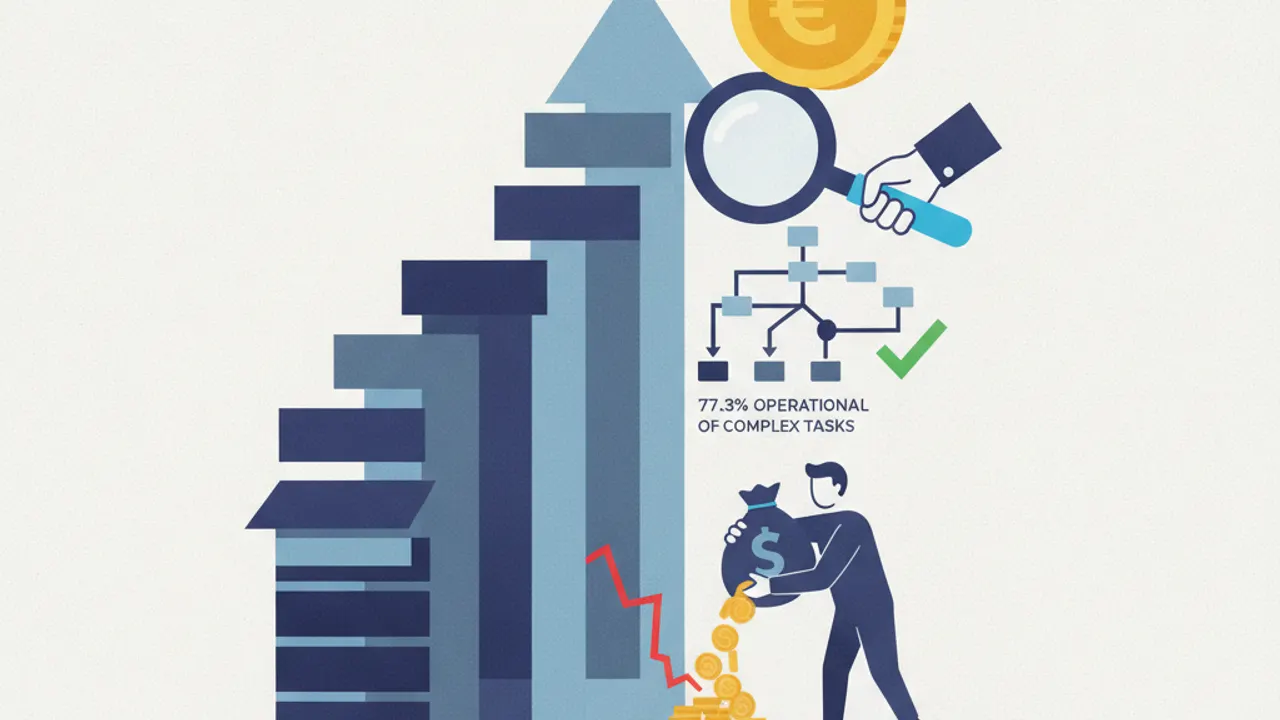
In 2026, the global tech sector is experiencing a massive shift toward autonomous systems, as documented by research from Stanford HAI, McKinsey, and Deloitte. Global corporate investments in AI rose to 581.7 billion US dollars, with 344.7 billion US dollars originating from private investments. Concurrently, a technological leap occurred in agentic AI, referring to autonomously operating AI agents. The success rate of these agents in solving complex, real-world tasks climbed from 20 percent in 2025 to 77.3 percent in 2026.
While technology matures and 88 percent of companies worldwide now use AI in at least one business unit, financial returns often lag behind expectations. According to McKinsey, 62 percent of companies are already testing or deploying AI agents, yet only 39 percent report a tangible contribution to overall profitability. Deloitte supports this finding, reporting that 42 percent of IT leaders currently experience low or no ROI. The main causes are poor data quality, legacy systems, and unclear governance structures.
A significant gap is also evident in actual day-to-day tool adoption within organizations. According to Deloitte data, the share of employees with approved access to AI tools increased from under 40 percent to approximately 60 percent. However, less than 60 percent of these authorized employees actually use the tools on a regular basis. Experts emphasize that simply purchasing software licenses without redesigning business processes fails to deliver meaningful productivity gains.
Despite these hurdles, 55 percent of executives expect exponential productivity gains once workflows are systematically reorganized around human-AI collaboration. At the same time, this transformation creates shifting demands in the labor market and increased strain on workers. The Stanford AI Index highlights a noticeable squeeze on entry-level positions, as routine tasks for junior staff are increasingly automated. Furthermore, the McKinsey Health Institute reports that the rapid pace of transformation leads to burnout symptoms in one out of five workers.
Geopolitical competition is also witnessing remarkable shifts in 2026. The performance gap between top American and Chinese AI models has nearly closed over the past year. This convergence increases pressure on global enterprises to future-proof their AI strategies, not only technologically but also in terms of governance and process design. The transition from simple chatbots to autonomous agents thus demands a fundamental rethinking across organizations worldwide.